
Last Updated: October 31, 2026
Quick Summary
Choose high-end bathroom faucets by first measuring your sink, countertop and hole count, then comparing single-handle, widespread, centerset and wall-mounted layouts. Solid brass or stainless steel bodies with ceramic disc cartridges offer the best durability, and the finish should suit your daily cleaning routine.
- Count existing sink or countertop holes and note their spacing before buying any faucet.
- Single-handle faucets are simpler to install and easier to operate with one hand.
- Solid brass or stainless steel bodies with ceramic disc cartridges indicate strong build quality.
- Brushed nickel hides fingerprints and water spots better than polished chrome or matte black.
- Compare fixtures on cost per year of service, not on sticker price alone.
Table of Contents
- Start With Your Sink, Countertop and Layout
- Single-Handle vs. Widespread Bathroom Faucets
- Bathroom Faucet Materials and Construction Quality
- Choosing Bathroom Faucet Finishes That Hold Up
- How to Match Bathroom Fixtures and Hardware
- Weighing the Total Cost of a High-End Fixture
- Booking a Fixture Review Before You Order
- Frequently Asked Questions
Start With Your Sink, Countertop and Layout
Choosing a high-end bathroom faucets set starts with the parts it has to fit. A common mistake is buying a faucet online and then discovering the spout does not reach the basin or the holes do not line up.
Your sink and countertop decide most of your options. A single-hole sink takes a single-handle faucet with a deck plate or a mounting hole. A three-hole sink suits a widespread faucet.
A Compatibility Checklist for Faucet, Sink and Countertop
Work through this list before you commit to any bathroom faucet:
- Count the existing holes in the sink or countertop, and note their spacing
- Confirm the countertop thickness, since it limits the mounting hardware you can use
- Check the spout reach so the water lands in the centre of the basin
A surprising number of problems trace back to a mismatch between the faucet and the sink. Lining up these details first saves time and a return shipment.
Single-Handle vs. Widespread Bathroom Faucets
Faucet configuration is really a question of how many holes you have, how much deck space the vanity offers, and who will be using the tap every day. The two most common layouts are single-handle and widespread, but they are not the only options, and the right answer often depends on the sink, the countertop and the people in the household.
Single-handle faucets
A single-handle faucet uses one lever to control both temperature and flow. It is the more common choice in modern bathrooms, and it is simple to clean and operate. It fits sinks with one hole, or a three-hole setup with a deck plate. Because the lever sweeps from cold to hot in one motion, it is also the easiest configuration to operate with one hand, a real advantage for children, older adults, and anyone with limited grip strength or mobility.
Widespread faucets
A widespread faucet uses separate hot and cold handles, with the spout mounted on its own. The look is more traditional and often more sculptural. The trade-off is that it needs three mounting holes, so it is harder to fit into an existing vanity without modification. Widespread sets also have more parts to clean around, and two handles mean two cartridges to service over the life of the faucet.
Centerset faucets
A centerset faucet combines the spout and two handles on a single base that sits on a three-hole sink with four-inch centers. It is compact and less expensive than a widespread set, but it offers less design flexibility and is harder to upgrade later without changing the sink.
Wall-mounted faucets
Wall-mounted faucets skip the deck entirely, which frees up countertop space and makes cleaning the sink easier. They require the plumbing to be roughed in behind the wall at the correct height and spread, so they are best planned during a renovation rather than retrofitted. If you are weighing a wall-mount against a deck-mount, this is the point where a bathroom renovation plan and a fixture review need to happen together.
Thermostatic and pressure-balance valves
A thermostatic valve lets you set an exact water temperature and holds it, while a pressure-balance valve adjusts the hot and cold mix to keep temperature steady when another fixture is used. Both are common in shower trim, and matching the valve family to the faucet trim keeps the look and the performance consistent across the room.
Touchless and motion-sensor faucets
Touchless faucets activate on a hand wave or proximity sensor. They reduce contact with the handle, which some households prefer for hygiene, but they need a power source (battery or hardwired) and the sensor electronics add a service item that a purely mechanical faucet does not have.
How to choose between them
- Choose single-handle when you want simplicity, easier installation, and one-hand operation.
- Choose widespread when the sink already has three holes and you want a classic, sculptural look.
- Choose centerset when the sink is a standard three-hole, four-inch-center model and budget matters.
If anyone in the household has limited mobility or grip strength, prioritize a single-handle lever or a touchless model, and keep the lever on the side of the sink that is easiest to reach.
A surprising number of problems trace back to a mismatch between the faucet and the sink. Lining up these details first saves time and a return shipment.
Bathroom Faucet Materials and Construction Quality
The body material affects durability more than almost any other feature.
Look beyond the material name and check the valve or cartridge. A ceramic disc cartridge is a strong sign of build quality and generally offers smooth, drip-free operation for years.
Construction details such as smooth internal finishing, solid mounting hardware and a clear warranty tell you far more than the marketing copy does.
Choosing Bathroom Faucet Finishes That Hold Up
Finish drives the look of the room, and it also determines how much upkeep the faucet needs. Polished chrome is bright, easy to clean and widely available. Brushed nickel hides fingerprints and water spots well.
Pick a finish that suits your daily routine as well as your design. A busy family bathroom may do better with brushed nickel than with a high-gloss black.
Real-World Care for Each Finish
Each finish has its own care needs:
- Polished chrome: Wipe with a soft cloth and mild soap. Avoid abrasive powders, which dull the shine.
- Brushed nickel: Clean with warm water and a mild cleaner, and wipe in the direction of the grain.
- Matte black: Use only non-abrasive, pH-neutral cleaners. Harsh products can leave marks that cannot be buffed out.
- Unlacquered brass: Expect the finish to patina over time. Some owners like this look, but it will change with use.
Check the manufacturer’s care instructions before you buy, as they vary by product.
How to Match Bathroom Fixtures and Hardware
A faucet should coordinate with the rest of the room. Match the finish across the faucet, towel bars, robe hooks, cabinet pulls and shower trim, so the bathroom reads as one design. Mixing finishes can work, but it takes a clear plan.
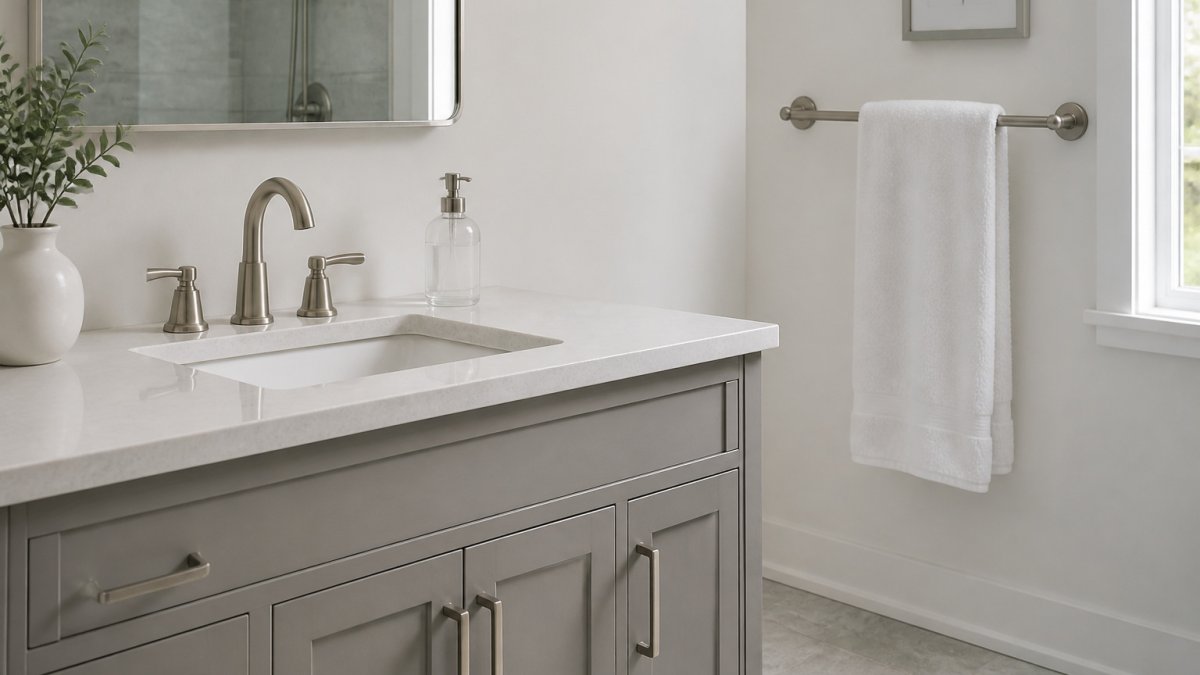
Keep the style consistent too. A sleek, minimal faucet suits clean-lined hardware, while a traditional spout pairs better with ornate pulls.
Weighing the Total Cost of a High-End Fixture
The sticker price is only part of the cost. Installation complexity, replacement parts, and how long the finish lasts all add to the total. A faucet that needs a new cartridge after a few years, or a finish that wears quickly, costs more over time than its purchase price suggests.
The four cost layers to compare
- Purchase price. The faucet, the trim, the valve (if sold separately), and any deck plate or escutcheon.
- Installation. A like-for-like swap on an existing sink is straightforward. A change in hole count, spread, or mounting type, or a move to wall-mount, can require plumbing and countertop work that dwarfs the fixture price.
- Service parts. Cartridges, aerators, O-rings, and finish touch-up kits. A faucet with widely available, inexpensive cartridges is cheaper to own than one with proprietary parts that must be ordered from a single source.
- Replacement. How long the finish and the valve actually last under daily use, and whether the warranty covers the parts that fail.
What drives long-term cost up
- Thin plated zinc bodies. The plating can wear through, exposing the base metal, and the faucet usually cannot be refinished economically.
- Proprietary cartridges. If the cartridge is only sold through one distributor, a failed cartridge can mean a long wait or a full faucet replacement.
- Finishes that show wear. Matte black and unlacquered brass look striking, but they show water spots and patina faster than brushed nickel or chrome, which raises the cleaning and refinishing burden.
- Complex installation. Wall-mount, thermostatic, and touchless models add plumbing, electrical, or valve work that a simple deck-mount does not.
What keeps long-term cost down
- Solid brass or stainless steel bodies with a ceramic disc cartridge, which are the most repairable and longest-lived combination most practitioners see.
- Standard, widely stocked service parts so a cartridge replacement is a same-week job, not a special order.
- A finish that suits the household. A busy family bathroom usually does better with brushed nickel than with a high-gloss black that shows every fingerprint.
- A warranty that covers the cartridge and finish, not just the body.
Compare fixtures on cost per year of service, not on sticker price alone. A faucet that lasts twice as long and takes a standard cartridge often costs less per year than a cheaper model that needs replacing.
Pricing for specific products depends on the model, finish and whether installation needs plumbing changes, so getting a current quote is the best next step. Our bathroom remodel cost guide breaks down how fixture choices affect the overall budget, and you can start with a free quote there. If you are planning a larger project, a full bathroom renovation may also change which fixtures make sense. Our guide on bathtub renovation planning covers how fixture choices fit into a broader timeline, and For ways to keep the overall budget on track, see practical budget management tips. If you are also updating the vanity, bathroom vanity installation services can affect both the fixture budget and the faucet layout, since the vanity top determines the hole count and spread you have to work with.
The sticker price is only part of the cost, so the article breaks the total down into the layers to compare.
| Cost layer | What it covers | Long-term effect |
|---|---|---|
| Purchase price | Faucet, trim, valve, deck plate or escutcheon | Starting point only |
| Installation | Hole count, spread, mounting type changes | Can outweigh the fixture price |
| Service parts | Cartridges, aerators, O-rings, touch-up kits | Standard parts keep repairs cheap |
| Replacement | Finish and valve life, warranty coverage | Shows real cost per year |
Booking a Fixture Review Before You Order
If you are unsure whether a faucet will fit, a professional review can save you from an expensive mistake. If you want to confirm who you would be hiring, our guide to hiring a licensed bathroom contractor in Vancouver explains what to look for.
Bathroom Renovators can review your existing fixtures and help you choose a faucet and hardware set that fits your sink, your layout and your budget. Reach out for a free consultation to start planning with confidence.
Frequently Asked Questions
What should I look for when buying a high-end bathroom faucet?
Start with construction and warranty rather than looks alone. Solid brass bodies, ceramic disc cartridges and a clear warranty term are reliable signs of quality. Check the flow rate, confirm the spout reach clears your sink, and look at whether replacement cartridges and parts are easy to source. Finish matters too, but a durable body and serviceable valve will serve you longer than a striking finish on a cheap core.
How do I choose a bathroom faucet that fits my sink?
Measure the number and spacing of mounting holes in your sink or countertop before shopping. Single-hole sinks suit single-handle faucets, while three-hole sinks suit widespread or centerset models. Check the spout reach so it lands over the basin, not the rim, and confirm the faucet height gives enough clearance for your hands and any vanity mirror. Taking the sink and countertop details to a plumber avoids most fit problems.
Which bathroom faucet finish is easiest to maintain?
Brushed nickel and PVD-coated finishes generally resist water spots and fingerprints better than polished chrome, which shows mineral deposits quickly. Matte black and brushed brass also hide wear well. Clean any finish with a soft cloth and mild soap, and avoid abrasive pads or harsh chemicals, which can dull coatings over time.
Should bathroom faucets and hardware match?
They do not have to match exactly, but they should share a finish family so the room looks coordinated. Mixing warm and cool tones is where most rooms start to look unplanned. Pick one finish for the faucet, then choose towel bars, robe hooks and cabinet pulls that either match it or sit within the same tone.

