
Table of Contents
- Most Durable Bathroom Countertop Materials: Quick Comparison
- How We Ranked These Bathroom Countertop Materials
- Bathroom Countertop Materials Pros and Cons: The Top 10
- Quartz vs Granite Bathroom Countertops: Which Wins for Busy Families?
- Low-Maintenance Bathroom Countertops: What Actually Holds Up
- Child Safety, Repairability, and Long-Term Ownership
- Choosing a Countertop for Your Bathroom Renovation
- Conclusion
- Frequently Asked Questions
Last Updated: October 7, 2026
Most Durable Bathroom Countertop Materials: Quick Comparison
Which surface survives splashes, spills, and daily use without constant attention? This guide from Bathroom Renovators ranks the top 10 durable bathroom countertop materials for families by porosity, stain resistance, and repairability.
Bathroom countertop materials split into engineered surfaces and natural stone.
Here is the short version before we break down each material:
| Material | Water Resistance | Maintenance | Best For |
|---|---|---|---|
| Quartz | Excellent | Low | Busy family bathrooms |
| Porcelain | Excellent | Low | Sleek, modern vanities |
| Granite | Good (sealed) | Medium | Statement countertops |
| Quartzite | Good (sealed) | Medium | Natural stone lovers |
| Solid Surface | Excellent | Low | Seamless, repairable tops |
| Soapstone | Good | Medium | Vintage-style bathrooms |
| Marble | Fair (sealed) | High | Low-traffic powder rooms |
| Concrete | Good (sealed) | Medium | Industrial styling |
| Butcher Block | Fair (sealed) | High | Warm, cottage looks |
| Laminate | Fair | Low | Budget refreshes |
A countertop that lasts comes down to how the material handles moisture and daily wear.
How We Ranked These Bathroom Countertop Materials
We scored each material on five factors: water and moisture resistance, stain resistance, scratch and impact resistance, maintenance, and repairability.
A polished finish can hide porosity problems until a spill sets in, so we ranked materials by how they behave after years of daily wear, not how they photograph on day one.
Here is the scorecard we used:
| Factor | Why It Matters |
|---|---|
| Water resistance | Guards against swelling, staining, and mold |
| Stain resistance | Handles toothpaste, soap, and cosmetics |
| Scratch resistance | Survives dropped bottles and jewelry |
| Maintenance | Sealing, cleaning, and refinishing effort |
| Repairability | Whether damage can be fixed or means replacement |
Ask for a sample and leave a few drops of water and a smear of toothpaste on it overnight. How the surface looks the next morning tells you more about real-world performance than any showroom display.
Bathroom Countertop Materials Pros and Cons: The Top 10
Each material below is scored on the same seven criteria: stain resistance, scratch resistance, water resistance, impact resistance, maintenance, repairability, and family fit.
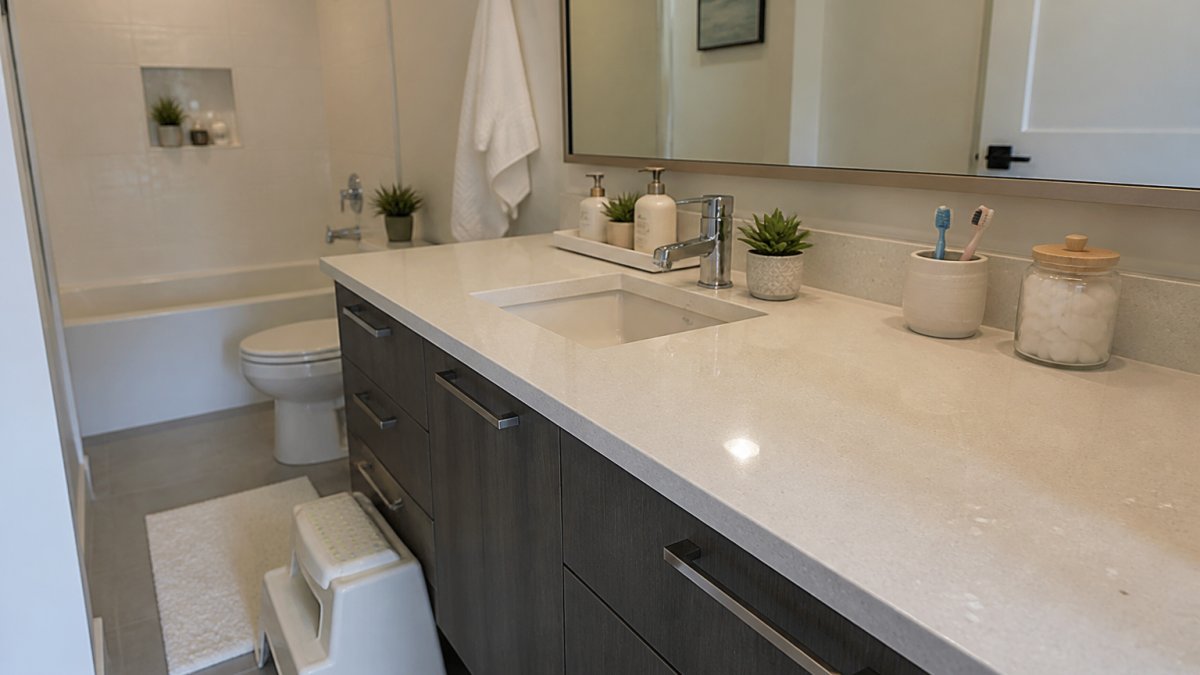
1. Quartz
Engineered quartz is the most durable choice for most family bathrooms. It is nonporous, so water, toothpaste, and cosmetics stay on the surface, and it never needs sealing.
- Stain resistance: Excellent, pigments and oils wipe away.
- Scratch resistance: Good, resistant to everyday contact but not to a dropped blade or heavy tool.
- Water resistance: Excellent, nonporous.
Bathroom limitation: Prolonged direct heat from a styling tool can discolor the resin binder. Set hot tools on a trivet, not the counter.
2. Porcelain
Porcelain slabs bring the look of stone with the toughness of fired ceramic. The nonporous surface resists water, stains, and bacteria.
- Stain resistance: Excellent.
- Scratch resistance: Good.
- Water resistance: Excellent.
Bathroom limitation: Thin porcelain slabs need experienced fabrication; a poorly supported edge is where chips start.
3. Granite
Granite is a natural stone prized for strength and one-of-a-kind veining. Properly sealed, it resists water and stains well.
- Stain resistance: Good when sealed; oils can penetrate if the sealer wears.
- Scratch resistance: Very good.
- Water resistance: Good when sealed.
Bathroom limitation: Standing water around a slow-draining sink can work past a failing sealer and leave a dark ring.
4. Quartzite
Quartzite rivals granite in hardness and offers the look of marble with better durability, though it still needs sealing to keep moisture out.
- Stain resistance: Good when sealed.
- Scratch resistance: Very good.
- Water resistance: Good when sealed.
Bathroom limitation: Porous if neglected; hair dye and cosmetics can leave permanent marks on an unsealed surface.
5. Solid Surface
Solid surface materials are man-made and nonporous, with one standout advantage: scratches and burns sand out.
- Stain resistance: Very good.
- Scratch resistance: Fair, shows fine scratches over time.
- Water resistance: Excellent.
Bathroom limitation: Hot styling tools can scorch the surface; the mark sands out but the habit is worth breaking.
6. Soapstone
Soapstone is a soft natural stone with a matte, vintage feel. It resists water and stains well but scratches more easily than granite.
- Stain resistance: Very good, naturally nonporous.
- Scratch resistance: Fair, scratches and darkens with use.
- Water resistance: Very good.
Bathroom limitation: Oiling is part of ownership; skip it and the surface dulls unevenly.
7. Marble
Marble is beautiful but the least forgiving natural stone in a wet bathroom. It is porous and etches easily, so it suits low-traffic powder rooms better than family main baths.
- Stain resistance: Fair, pigments penetrate quickly.
- Scratch resistance: Fair.
- Water resistance: Fair when sealed.
Bathroom limitation: Toothpaste, mouthwash, and acidic cleaners etch the polished surface within minutes.
8. Concrete
Concrete offers an industrial look and can be sealed for good water resistance. It is heavy and can develop hairline cracks over time.
- Stain resistance: Good when sealed.
- Scratch resistance: Moderate.
- Water resistance: Good when sealed.
Bathroom limitation: Sealer wears unevenly around the sink, so the wettest zone needs attention first.
9. Butcher Block
Butcher block brings warmth but needs the most care here: regular sealing and oiling to stand up to moisture.
- Stain resistance: Fair.
- Scratch resistance: Fair, scratches sand out.
- Water resistance: Fair when sealed.
Bathroom limitation: Standing water around the sink swells the wood and stains the grain if the sealer fails.
10. Laminate
Laminate is the budget pick. Modern laminate resists stains and moisture reasonably well, but cannot be repaired once the surface wears through.
- Stain resistance: Good.
- Scratch resistance: Fair.
- Water resistance: Fair, seams and edges are vulnerable.
Bathroom limitation: Water that reaches the substrate through a lifted edge causes swelling that cannot be reversed.
Family-fit recommendations by household
- Busy shared bathroom with young children: Quartz or porcelain, nonporous, easy to wipe, minimal upkeep.
- Household that wants damage to be fixable: Solid surface or soapstone, sanded and refinished on site.
- Natural-stone lovers willing to seal: Granite or quartzite, character with a maintenance routine.
Quartz vs Granite Bathroom Countertops: Which Wins for Busy Families?
Quartz wins for most busy families: it is nonporous, needs no sealing, and resists stains and moisture with minimal effort.
The choice comes down to upkeep. For a surface that looks the same in five years with just a wipe-down, quartz is the safer bet.
For a family bathroom, we lean toward quartz nearly every time, it handles toothpaste smears and wet hands without complaint.
Low-Maintenance Bathroom Countertops: What Actually Holds Up
The lowest-maintenance bathroom countertop materials are quartz, porcelain, and solid surface. All three are nonporous, resist stains, and clean up with soap and water. None require sealing.
Natural stone, by contrast, needs periodic sealing. Marble and butcher block sit at the high-maintenance end.
A quick maintenance comparison:
| Material | Sealing Needed | Daily Cleaning | Long-Term Care |
|---|---|---|---|
| Quartz | No | Soap and water | Minimal |
| Porcelain | No | Soap and water | Minimal |
| Solid Surface | No | Soap and water | Occasional sanding |
| Granite | Yes | Mild cleaner | Reseal periodically |
| Marble | Yes | pH-neutral cleaner | Frequent sealing |
Never use abrasive cleaners or scouring pads on any countertop. They dull the finish and open tiny scratches where stains and bacteria collect, cutting the surface’s lifespan short.
Child Safety, Repairability, and Long-Term Ownership
Durability in a family bathroom is not just about resisting water, it is about dropped shampoo bottles, toothpaste smeared across the vanity, and wet towels left on the edge overnight. Here are the wear patterns that show up in busy households and how each surface holds up.
Real family wear scenarios
In practice, the damage families see comes from a predictable short list:
- Toothpaste and mouthwash, mildly abrasive and slightly acidic, left to dry into a chalky film that can etch porous stone if not wiped promptly.
- Hair dye and cosmetics, pigments in hair dye, foundation, and nail polish can penetrate unsealed stone within minutes; nonporous surfaces keep them on top where they wipe away.
- Dropped toiletries, glass bottles, metal cans, and ceramic soap dishes chip edges on impact. Harder surfaces resist chipping but transmit the shock; softer surfaces dent or scratch instead.
Child safety considerations
For households with young children, three surface properties matter more than appearance:
- Edge profile. A rounded or bullnose edge on a low vanity reduces the severity of bumps and cuts compared with a sharp square edge. This is a fabrication choice, not a material choice, so it can be specified on almost any surface.
- Slip resistance around the sink. Polished surfaces become slick when wet. A honed or matte finish gives small hands and wet feet more grip on splash zones.
- Cleanability without harsh chemicals. Nonporous surfaces like quartz, porcelain, and solid surface can be cleaned with soap and water, which matters when children are helping wipe down the vanity.
Repairability: what can be fixed and what cannot
Repairability is where materials diverge most, and the factor families underestimate at purchase.
| Material | Chip Repair | Scratch Repair | Stain Removal | Verdict |
|---|---|---|---|---|
| Quartz | Difficult; resin fill visible | Usually permanent | Wipe away | Tough but not forgiving |
| Porcelain | Difficult; edge chips show | Usually permanent | Wipe away | Durable, hard to restore |
| Solid Surface | Sanded and blended | Sanded out | Sanded out | Most repairable |
| Granite | Professional epoxy fill | Professional polish | Poultice for oil stains | Repairable with a pro |
| Quartzite | Professional epoxy fill | Professional polish | Poultice for oil stains | Repairable with a pro |
| Soapstone | Sanded and oiled | Sanded out | Sanded out | Very repairable |
| Marble | Professional fill | Professional polish | Poultice; etching is permanent | Etching cannot be undone |
| Concrete | Patch compound | Refinish | Reseal | Repairable but finish-dependent |
| Butcher Block | Sanded out | Sanded out | Sanded out | Fully refinishable |
| Laminate | Not repairable | Not repairable | Usually permanent | Replace the section |
The pattern is clear: solid surface, soapstone, and butcher block can be restored on site, while quartz, porcelain, and laminate treat damage as permanent. Natural stone sits in the middle, repairable by a professional but rarely by the homeowner.
Long-term ownership costs beyond the surface
A countertop is not a one-time purchase. Over a decade of family use, ownership includes resealing stone every year or two, occasional professional polishing, and possible replacement if a laminate or porcelain edge chips badly. Nonporous engineered surfaces front-load the cost and then ask almost nothing afterward, which is why they tend to win on total ownership for busy households.
Match the material to the room’s traffic and to who will maintain it. Nonporous engineered surfaces suit busy family bathrooms; repairable surfaces like solid surface and soapstone suit households willing to refinish rather than replace; porous natural stone is better saved for low-use powder rooms.
Choosing a Countertop for Your Bathroom Renovation
Picking a countertop is a question of matching material to lifestyle.
The installation details matter as much as the material. A proper sink cutout, a well-sealed edge profile, and a level fit all affect how long a countertop lasts.
At Bathroom Renovators, we have spent over 26 years helping families across the North Shore and Greater Vancouver choose surfaces that hold up to real life.
Conclusion
Choosing a durable countertop is one of the most important decisions in a bathroom renovation, and the wrong material can mean years of stains, sealing, and regret. Bathroom Renovators helps families avoid that with quartz, porcelain, and other surfaces chosen for how they actually perform. Our team brings over 26 years of experience, finishes most projects in 7-10 days, and stands behind every job with a 1-year warranty.
Frequently Asked Questions
What is the best countertop material for a family with children?
Engineered quartz is the top pick for most families. It is nonporous, so spills from toothpaste, soap, and cosmetics sit on the surface instead of soaking in, and it resists scratches and stains from daily use. Porcelain runs a close second and handles heat better. Both wipe clean with mild soap and water, which matters when kids leave messes behind. Granite and quartzite also work well but need periodic sealing to stay protected against moisture.
Is quartz or granite better for a family bathroom?
Quartz suits busy family bathrooms better in most cases. Its nonporous surface resists stains, moisture, and bacteria without sealing, and it never needs resealing. Granite is harder to scratch and handles heat well, but its natural porosity means it requires sealing every one to two years. In a bathroom, where humidity stays high, quartz’s lower maintenance demands give it the edge for households with children.
What is the most durable, lowest-maintenance countertop?
Porcelain and quartz are the strongest contenders. Porcelain resists scratches, heat, and stains, and it does not need sealing. Quartz offers similar stain and moisture resistance with a wider range of colors and edge profiles. Both clean with a damp cloth and mild soap. Solid surface is another low-maintenance option because minor scratches can be sanded out, though it scratches more easily than quartz or porcelain.
Are porcelain countertops durable enough for bathrooms?
Yes. Porcelain countertops are fired at high temperatures, which makes them dense, hard, and resistant to scratches, stains, and heat. They are nonporous, so moisture and bacteria cannot penetrate the surface, and they never need sealing. The main consideration is installation, since porcelain requires an experienced fabricator to cut sink openings and edge profiles without chipping. Once installed, porcelain holds up well to daily family use.
