
Table of Contents
- Sign 1: Cracked, Missing, or Crumbling Grout
- Sign 2: Loose, Moving, or Lifting Tiles
- Sign 3: Discolored Tiles or Yellow-Brown Staining
- Sign 4: Swollen Baseboards, Warped Skirting Boards, or Peeling Paint
- Sign 5: Water Pooling or Excessive Moisture Around the Shower or Tub
- How to Tell If Water Is Getting Behind Tile: Safe, Non-Destructive Checks
- Mold Behind Shower Tiles: What It Looks and Smells Like
- How Long Walls Take to Dry After Water Damage
- Frequently Asked Questions
Last Updated: October 5, 2026
Sign 1: Cracked, Missing, or Crumbling Grout
Cracked, missing, or crumbling grout is often the first visible sign of water damage behind bathroom tiles. Grout is the cement-based filler between tiles, and it is not waterproof on its own.
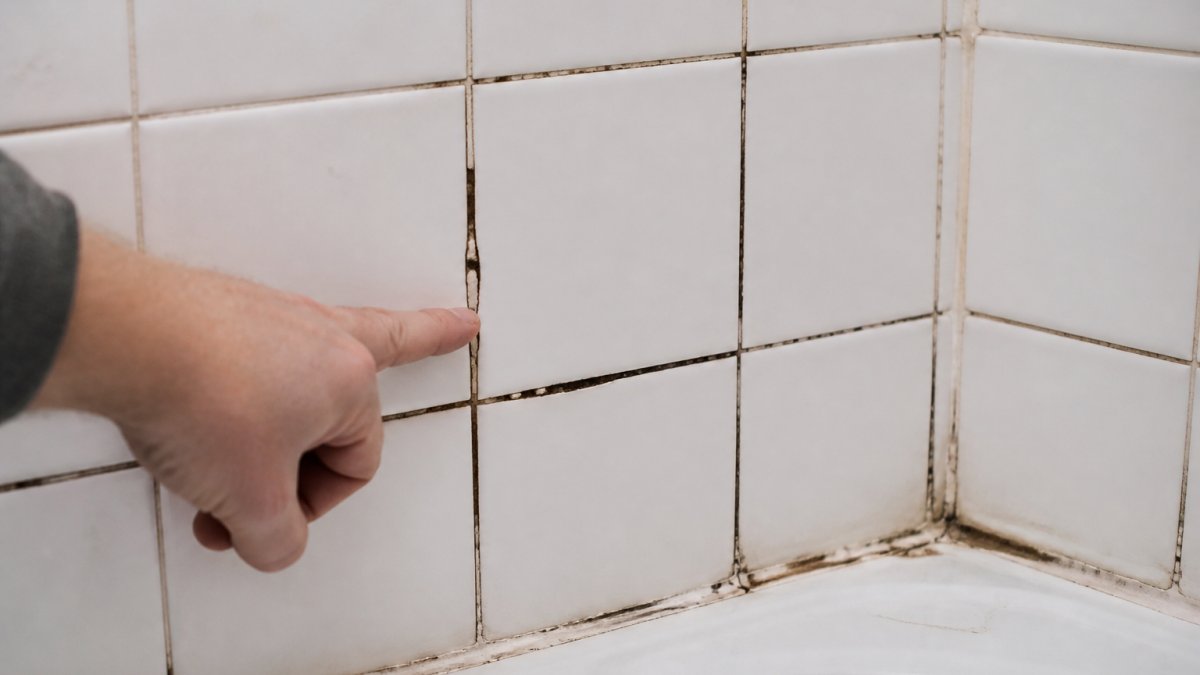
Grout cracks for predictable reasons. Houses shift. Steam expands and contracts the wall. Old grout dries out and turns powdery.
Run your finger along the grout lines. Healthy grout feels hard and smooth. Failing grout feels sandy, soft, or hollow.
Small hairline cracks are easy to ignore. That is the mistake. Water follows the path of least resistance, and a crack the width of a hair is enough to soak the wall behind it over months of daily showers.
Sign 2: Loose, Moving, or Lifting Tiles
A tile that moves under your hand means the bond behind it has already failed.
Press gently on each tile in the shower area. A solid tile feels firm and dead under your fingers.
Look for tiles that sit proud of their neighbors. Lifting at the edges is a classic sign of water buildup behind the surface.
Here is the honest part most guides skip: replacing one loose tile rarely fixes the problem.
Sign 3: Discolored Tiles or Yellow-Brown Staining
Discoloration on or between tiles is a moisture signal you should not dismiss. Yellow or brown staining usually means water is sitting behind the tile and leaching minerals and organic matter back through the surface.
Staining shows up in two places. First, in the grout lines, which darken and hold color even after scrubbing.
The key distinction is whether the stain is on the surface or under it. Surface soap scum scrubs away.
Clean the area, dry it fully, then check again in 48 hours. If the stain reappears without anyone using the shower, the moisture is coming from behind the tile, not from the surface.
Sign 4: Swollen Baseboards, Warped Skirting Boards, or Peeling Paint
Damage outside the shower is often the clearest proof that water is traveling through the wall. Swollen baseboards, warped skirting boards, and peeling paint on the wall beside or below the shower are strong indicators of hidden moisture.
Water does not stay where it lands. It wicks downward and sideways through drywall and framing.
Check these spots:
- Baseboards near the shower, which feel soft or pull away from the wall
- Paint that bubbles, blisters, or flakes without a clear cause
- Swollen plaster or drywall that feels cool and damp to the touch
If the wall damage is this advanced, surface repairs will not hold. The moisture source has to be found and fixed first.
Sign 5: Water Pooling or Excessive Moisture Around the Shower or Tub
Standing water and constant dampness around the shower or tub keep feeding the problem. Water pooling at the base of the shower, or a floor that never quite dries, means moisture is finding its way into places it should not stay.
Watch for these patterns:
- Water that seeps out from under the shower base or tub edge
- A floor that stays damp long after the shower is done
- Sealant that has pulled away from the tile-to-tub joint
Some of this is normal surface moisture. The difference is persistence. A shower that dries within a couple of hours is fine. One that stays wet all day is telling you something.
How to Tell If Water Is Getting Behind Tile: Safe, Non-Destructive Checks
You can check for hidden tile damage without tearing anything apart. These checks are safe, quick, and need no special tools.
- Tap test. Tap each tile with a plastic screwdriver handle. A hollow sound suggests the tile has separated from the wall.
- Press test. Press gently on tiles near the shower base and corners. Any give or movement is a red flag.
- Grout probe. Run a fingernail along the grout. If it crumbles or feels soft, the joint has failed.
- Sealant check. Look at the caulk line where tile meets tub. Pulled-away or cracked sealant lets water straight through.
- Moisture check nearby. Feel the baseboards and wall on the other side of the shower. Cool, soft, or damp spots confirm travel.
- Smell test. A musty odor that returns after cleaning points to moisture trapped in the wall.
Compare what you find against routine wear. Surface condensation dries and leaves no trace. Hidden water damage keeps coming back.
Mold Behind Shower Tiles: What It Looks and Smells Like
Mold behind shower tiles is a moisture problem first and a cleaning problem second. It shows up as dark speckling in the grout, a musty smell that returns after cleaning, and staining that keeps coming back, but the growth itself lives in the damp, dark cavity between the tile and the wall, so you often smell it before you see it.
Why mold grows behind tile, not just on it
Mold needs three things: moisture, organic material, and still air. A bathroom supplies all three. Grout and tile adhesive are porous. Drywall paper, wood framing, and the paper facing on gypsum board are organic.
Surface mildew, the kind that wipes off with a bathroom cleaner, is usually a ventilation issue. Concealed mold is a water-intrusion issue. The two look similar and get confused constantly.
How to tell surface mildew from hidden mold
- Surface mildew appears on the tile face, grout lines, or caulk, wipes away with a cleaner, and does not return for weeks if ventilation improves.
- Hidden mold reappears within days of cleaning, spreads along grout lines in a pattern that follows water travel, and often comes with a musty smell that lingers even when the room looks clean.
- A telltale sign: if the smell is strongest when the bathroom has been closed up, or right after a shower, moisture is feeding growth behind the surface.
Health considerations worth taking seriously
Health Canada and the Canadian Mortgage and Housing Corporation (CMHC) both note that indoor mold exposure can aggravate allergies, asthma, and other respiratory conditions, particularly in children, older adults, and people with compromised immune systems. You do not need visible black mold to have a problem, the smell alone is a reasonable trigger to investigate.
If anyone in the household has asthma or mold allergies, treat a recurring musty smell as a priority rather than a nuisance.
Why cleaning the surface is not enough
Cleaning kills what you can reach. It does nothing about the moisture feeding the growth. If the source, a failed tile-to-tub joint, cracked grout, or a slow leak behind the wall, is still active, mold returns within days. Repeated cleaning without fixing the source is one of the most common patterns renovators see when they open up a shower wall.
Do not assume bleach spray solves the problem. Bleach kills surface mold but does not penetrate porous grout, drywall, or framing. If the growth is behind the tile, the moisture source has to be found and corrected first.
When to stop cleaning and start investigating
If you have cleaned thoroughly, improved ventilation, and the mold still returns within a week or two, the moisture is coming from behind the tile. That is the point to move from cleaning to diagnosis, moisture assessment, locating the leak, and rebuilding the waterproofed wall. For homeowners weighing a targeted repair against a larger refresh, a bathroom-renovator who understands concealed moisture damage can advise on the right scope before any tile comes off.
How Long Walls Take to Dry After Water Damage
Walls typically take several days to a few weeks to dry after water damage, depending on how long moisture has been trapped, what materials are wet, and whether the source has actually been stopped. A small leak caught early dries far faster than one that has soaked insulation and framing for months.
What actually determines drying time
- Duration of exposure. A leak that started last week behaves very differently from one that has been seeping for a year.
- What is wet. Surface moisture on tile dries quickly. Saturated drywall, fiberglass or mineral-wool insulation, and wood framing hold water far longer.
- Ventilation and airflow. A bathroom with a working exhaust fan and an open window dries faster than a sealed, humid room.
Why drying fails when the source is still active
Drying only works once the water source is fixed. If a failed sealant, cracked grout, or a slow supply-line drip keeps feeding the wall, the cavity never dries out, no matter how long you wait or how much air you move through the room. This is why renovators almost always locate and stop the leak before any drying or rebuild begins.
The realistic sequence after a leak is found
- Stop the source. Repair the failed joint, sealant, or plumbing.
- Assess the extent. Moisture meters and, in some cases, thermal imaging map how far water has traveled.
- Dry the cavity. Air movers and dehumidifiers, or removal of saturated materials if drying is not viable.
- Verify dryness. Drying is confirmed with a moisture meter, not by touch.
- Rebuild the waterproofed wall. Only after the assembly is dry should tile, backer board, and waterproofing go back on.
Skipping step four is one of the most common causes of repeat damage. Tile laid over a damp wall traps moisture and starts the cycle again.
What this means for a renovation decision
If the damage is limited to a small area and the source is fixed quickly, a targeted repair may be enough. If moisture has spread through the wall assembly, insulation, or framing, a partial rebuild, or a full bathroom renovation, is often the more durable path. Homeowners comparing options should ask any bathroom-renovator they consult how they verify dryness before closing up the wall.
Drying time is a symptom, not a schedule. If a wall is not drying, the source is still active, the vapor barrier is trapping moisture, or the wet materials need to come out. Those are the three things to check before assuming more time will solve it.
If you spot several of these signs at once, it is time to bring in a professional. At Bathroom Renovators, we have spent over 26 years renovating bathrooms across the North Shore and Greater Vancouver, and we know how local moisture treats a poorly sealed shower. We complete most projects in 7-10 days, spec materials that hold up to our damp climate, and back our work with a 1-year warranty. If you are weighing a repair against a full refresh, our team can walk you through both. We also handle bathroom renovations in Coquitlam and Port Moody for homeowners who want the job done right the first time.
Frequently Asked Questions
How to tell if water is getting behind tile?
Look for cracked or missing grout, loose tiles that move when pressed, and discolored grout lines. Check for swollen baseboards or peeling paint on nearby walls. A simple non-destructive test is to press gently on tiles, tap them with a plastic handle to listen for hollow sounds, and inspect the sealant along the tub or shower base. If you notice any of these signs, water damage is likely present.
How long does it take to dry out walls from water damage?
Walls typically take several days to a few weeks to dry, depending on how long moisture has been trapped, what materials are wet, and whether the source has actually been stopped. Without proper equipment, drying can take weeks and may not fully remove moisture trapped behind tiles. In Vancouver’s humid climate, drying takes longer. If the drywall or backer board is saturated, it often needs removal and replacement rather than just drying. A moisture meter helps confirm when walls are truly dry.
Should you remove tiles if water is getting behind them?
In most cases, yes. Water trapped behind tiles will continue to damage the substrate, promote mold growth, and weaken the tile adhesive. Removing affected tiles allows proper drying and inspection of the wall structure. If only a small area is affected, a targeted repair may work. For widespread damage, a full shower wall replacement is often more reliable and cost-effective long-term.
When should you call a professional about water damage behind bathroom tiles?
Call a professional when you see multiple signs, such as loose tiles plus swollen baseboards, or when mold is visible or you smell a musty odor. If the damage covers more than a small area or the wall feels soft, professional help is needed. A pro can assess hidden damage, ensure proper drying, and repair waterproofing correctly to prevent recurrence.
Water damage behind bathroom tiles rarely fixes itself, and the longer it sits, the more it costs to put right. If you have spotted cracked grout, loose tiles, or swelling near the shower, get it checked before the damage spreads. Bathroom Renovators offers free quotes, custom designs built around your space, and projects finished in 7-10 days with minimal disruption to your home. Get your free consultation and find out exactly what is going on behind those tiles.
