
Table of Contents
- What Large Format Porcelain Tile Actually Means
- The Case for Large Format Porcelain Tile: Fewer Grout Lines, Bigger Feel
- Durability, Scratch Resistance, and Maintenance Realities
- What Large Format Tile Installation Cost Really Covers
- Subfloor Deflection, Adhesives, and Leveling Systems
- Where Large Format Porcelain Tile Falls Short
- Planning a Bathroom Reno in Vancouver: What to Expect
- Conclusion: Who Should Choose Large Format Porcelain Tile
- Frequently Asked Questions
Last Updated: September 28, 2026
What Large Format Porcelain Tile Actually Means
Large format porcelain tile is any tile with at least one side measuring 60 cm or more, up to full slabs over 1.5 metres long, from 60 x 60 cm squares to 120 x 260 cm slabs.
The Case for Large Format Porcelain Tile: Fewer Grout Lines, Bigger Feel
Fewer grout lines is the entire pitch, and it’s a good one. A standard 30 x 30 cm tile floor in a small bathroom might have 40 or more grout lines. Switch to 60 x 120 cm tiles and that count drops dramatically.
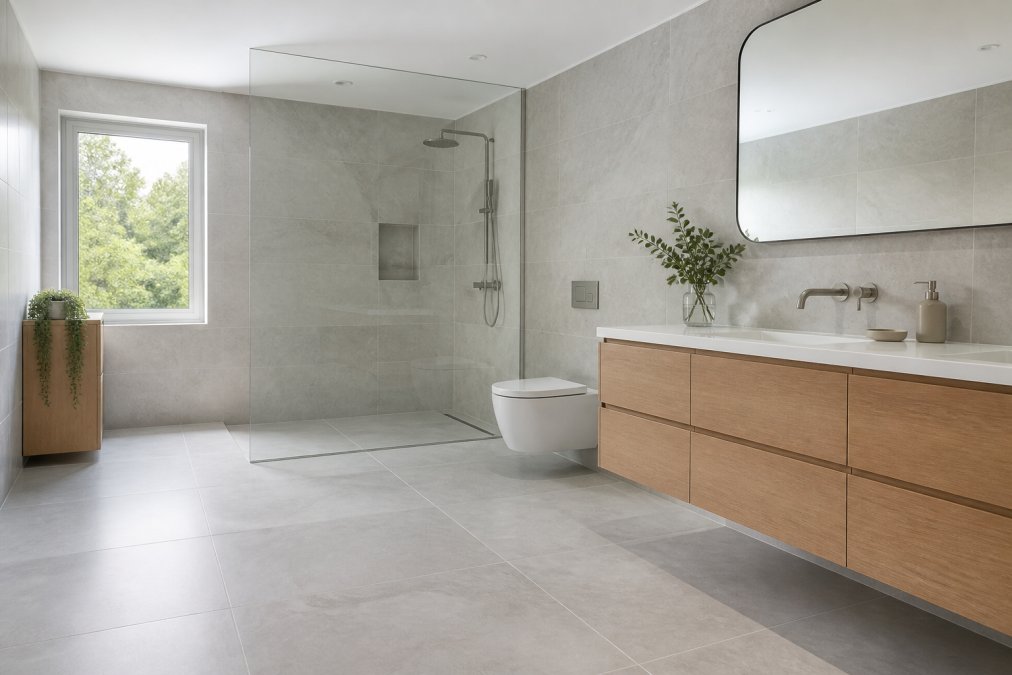
How Fewer Grout Lines Change a Small Bathroom
In a small bathroom, grout lines act like a visual grid that chops the floor into squares, and the room feels smaller as a result.
Durability, Scratch Resistance, and Maintenance Realities
Porcelain is one of the toughest bathroom flooring materials, scratch-resistant, heat-resistant, and won’t fade from sunlight or cleaning products.
Maintenance comes down to two jobs:
- Sweep or vacuum regularly to remove grit that can dull the surface over time
- Mop with a pH-neutral cleaner and skip anything abrasive
Ask your installer to use epoxy grout on bathroom floors. It costs more per bag, but with large-format tile you’re using so little that the total difference is minor, and it saves you years of scrubbing.
What Large Format Tile Installation Cost Really Covers
Large format tile installation cost is driven by labour and prep, not the tile itself. The material is often a smaller line item than the work required to make the floor ready for it.
Here’s where the money actually goes:
| Cost Driver | Why It Matters |
|---|---|
| Surface preparation | Floors must be flat to tight tolerances before any tile goes down |
| Floor leveling | Self-levelling compound or grinding to remove high spots |
| Subfloor repair | Fixing deflection, rot, or movement in the existing structure |
| Thin-set mortar | Large tiles need full coverage, which uses more adhesive |
| Leveling systems | Clips and wedges that hold tiles flat while the mortar cures |
| Labour time | Fewer tiles, but each one takes longer to set correctly |
How Large Format Compares to Standard Tile on Cost
On a like-for-like bathroom floor, large format porcelain installation can be higher than a standard 30 x 30 cm install once prep and labour are included. The tile itself is often comparable per square foot, sometimes cheaper, because you’re buying fewer pieces. The premium comes from three places:
- Prep. A floor that would pass for small tile often fails the flatness tolerance for a 120 cm slab. Self-levelling compound, grinding, or a new subfloor panel adds a real line item.
- Labour hours per tile. A 120 x 260 cm slab can take two installers most of a day to set, back-butter, and level. The same square footage in 30 x 30 cm tiles moves faster per unit of area.
- Waste. A miscut on a large slab wastes far more material than a miscut on a small tile, and off-cuts are rarely reusable on the next job.
What Actually Moves the Number
Three variables drive most of the spread between quotes:
- Subfloor condition. A flat, solid, deflection-compliant floor is the cheapest possible starting point. Rot, deflection, or a failed previous install can double the prep line.
- Tile size and format. A 60 x 120 cm tile is a different job from a 120 x 260 cm slab. The larger the format, the more hands, the more suction cups, and the more time per piece.
- Layout complexity. Herringbone, chevron, and intricate patterns waste more material and take longer than a straight stack or offset. A simple grid layout on a rectangular room is the cheapest way to run large format.
Pricing depends on your room size, subfloor condition, and the tile you choose. We give free quotes so you get a real number instead of a guess.
Ask any installer for a quote that separates tile, prep, and labour. If prep is bundled into a single number, you can’t tell whether the floor is being properly flattened or just tiled over.
Subfloor Deflection, Adhesives, and Leveling Systems
Subfloor deflection is how much your floor bends under load, and it’s the single biggest reason large-format installations fail. It’s measured as a ratio: L/360 means the floor can deflect 1/360th of its span.
Why Thin-Set Mortar and Back-Buttering Matter
Thin-set mortar bonds tile to the substrate, and large tiles need full coverage underneath, air pockets are the enemy.
Never let an installer skip a deflection check to save a day. If the floor flexes past L/360, large-format tile will crack, and the repair means removing tile, fixing the structure, and starting over.
Where Large Format Porcelain Tile Falls Short
Large format porcelain tile is not the right call for every bathroom. The honest limitations fall into two categories most guides skip: what happens when something goes wrong, and whether your structure can carry the load.
Repairability: The Long-Term Question Nobody Answers
If a single large tile cracks five years from now, you can’t pop it out and drop in a replacement the way you would with a 30 x 30 cm tile. Here’s why:
- Removal damages neighbours. A large tile is bonded across a wide area. Getting it up without chipping or cracking the tiles beside it takes a skilled hand, and even then, the waterproofing membrane underneath is often compromised.
- Dye lots shift. Porcelain is fired in batches, and the same model number can look noticeably different two or three years later. A patch repair on a floor or wall can read as a visible square.
- The fix is often a re-do. On a shower wall or a small bathroom floor, the practical repair is frequently to remove and replace the whole run, not a single piece. That’s a real cost to weigh against the aesthetic benefit.
Weight and Structural Load Limits
Large porcelain slabs are heavy. A 120 x 260 cm slab at 10 mm thick can weigh well over 60 kg, and thicker 20 mm slabs run considerably more. That weight matters in two places:
- Floors. A tiled floor adds dead load to the joists. On a second-storey bathroom or an older home with undersized joists, that load needs to be checked before the tile is ordered, not after.
- Walls. Hanging a large slab on a stud wall is a different job from hanging small tiles. The substrate needs to be rigid enough to carry the weight without flexing, and the adhesive has to hold it in place while it cures. On a plaster or drywall substrate, that usually means a cement backer board or a foam tile backer rated for the load.
The Other Real Limitations
- Installation complexity is high. Not every installer has the tools or experience for slabs this size. A bad install is expensive to undo.
- Cutting is unforgiving. A miscut on a large tile wastes far more material than a miscut on a small one.
- Cost is front-loaded. You pay more for prep and labour, even though the tile count is lower.
If your bathroom has a soft or uneven floor, a wall that can’t take the load, or you want the option to replace a single tile down the road, a mid-format tile may serve you better.
Before ordering large format tile for a second-storey or older-home bathroom, confirm the joist span, the subfloor thickness, and the wall substrate. Weight and deflection problems are far cheaper to solve before the tile arrives than after it cracks.
Planning a Bathroom Reno in Vancouver: What to Expect
A bathroom reno in Vancouver comes with its own conditions, and moisture tops the list. Coastal humidity and heavy rain mean materials need to handle damp air year-round, not just shower splashes.
- Gives you a clear timeline in writing
- Explains what happens if they find hidden damage
- Cleans up at the end of each day
- Backs the work with a written warranty
Conclusion: Who Should Choose Large Format Porcelain Tile
Large format porcelain tile is worth it if your subfloor can handle it, your installer knows what they’re doing, and you want a bathroom that’s easy to clean and looks bigger than it is.
Frequently Asked Questions
Do large format tiles make a small bathroom look bigger?
Yes. Large format porcelain tile reduces visual interruption because there are fewer grout lines breaking up the surface. In a small bathroom, that seamless look can make the space feel more open and continuous. The effect works best when tile is laid in one direction and grout color closely matches the tile. If you are planning a bathroom reno in Vancouver and want to maximize a compact footprint, large format tile is one of the most effective visual tools available.
Are large format tiles more prone to cracking than smaller tiles?
They can be if the subfloor is not properly prepared. Large format porcelain tile is dense and strong, but it does not flex. If the subfloor deflects beyond the L/360 rating, the tile can crack along with the grout. A stiff floor, correct thin-set mortar, and proper back-buttering reduce that risk significantly. This is why substrate preparation matters more with large format tile than with standard ceramic tile.
How does large format tile installation cost compare to standard tile?
Large format tile installation cost is typically higher than standard tile because the work is more demanding. You need floor leveling, a deflection check, the right thin-set mortar, and often a leveling system to control lippage. Larger tiles also require more careful cutting and handling. Pricing depends on tile size, substrate condition, and layout complexity. Request a free quote so the scope is clear before work begins.
What are the downsides of large-format tiles?
The main downsides are installation complexity, higher material and labor costs, and difficulty replacing a single tile if it cracks. Large format porcelain tile also requires a flatter substrate than smaller tile, which may mean additional floor leveling. Heavy slabs add structural load, so the subfloor must be assessed. In wet areas, poor installation leads to lippage and water intrusion. These risks are manageable with an experienced installer who checks deflection and uses the right adhesive.
Choosing the wrong installer is the fastest way to turn a great material into an expensive mistake. Bathroom Renovators has spent over 26 years renovating bathrooms across the North Shore and Greater Vancouver, completing most projects in 7-10 days with a 1-year warranty and a free quote before you commit. Get your free consultation and find out whether large format porcelain tile is right for your bathroom.
