
Table of Contents
- Water-Saving Fixtures and Aerators
- Energy-Efficient Bathroom Fixtures That Lower Your Bills
- Sustainable and Natural Materials for Your Remodel
- Biophilic Design Elements and Wellness-Focused Layouts
- Smart Technology and Home Automation
- Understanding Bathroom Remodel Cost and Timeline
- Retrofitting vs. Full Renovation: Which Approach Fits Your Needs
- Frequently Asked Questions
Last Updated: September 18, 2026
Water-Saving Fixtures and Aerators
Install water-saving fixtures, low-flow showerheads, faucet aerators, and dual-flush toilets, to cut water consumption without sacrificing performance. Understanding which upgrades are DIY-friendly and which require professional plumbing is essential for planning your renovation.
Faucet Aerators: The Easiest DIY Upgrade
Aerators mix air into water flow, maintaining pressure while using less water. A standard showerhead can use up to 9.5 litres per minute; low-flow models can reduce that to 7.5 litres or less, saving thousands of litres annually. Faucet aerators work the same way and cost just a few dollars to install.
Faucet aerators are the most DIY-friendly upgrade. Installation takes 2-3 minutes: unscrew the aerator, replace it with a low-flow model (approximately 5.7 litres per minute versus the standard 8.3), and screw it back on. Aerators cost $5-$15 each at hardware stores.
Low-flow showerheads are similarly DIY-friendly: unscrew the existing head, wrap plumber’s tape around the threads, and screw on the new model. The process takes 5 minutes and costs $20-$60.
Dual-Flush Toilets: Professional Installation Recommended
Dual-flush toilets offer a choice between a full flush and a half flush, reducing consumption by 30-50%. A standard toilet can use over 18 litres per flush; dual-flush models use approximately 11.4 litres for a full flush and 5.7 litres for a half flush.
Professional installation is recommended because improper wax ring seating can cause hidden water damage and mold growth. Professional plumbers complete replacement in 1-2 hours and guarantee a proper seal for $150-$300.
Low-Flow Showerheads with Thermostatic Valves: Mixed DIY Potential
Advanced low-flow showerheads with thermostatic mixing valves maintain consistent water temperature while reducing flow. If your shower already has a mixing valve, installation is DIY-friendly. If not, a plumber must install one for $200-$400, which may require opening walls.
Water Pressure Regulators: Professional Installation
If your home has high water pressure (above 80 PSI), a pressure regulator installed at the main water line reduces flow across all fixtures. This professional job costs $200-$400 and benefits your entire home.
Planning Your Water-Saving Retrofit
When planning an eco-friendly bathroom renovation, start with aerators and low-flow showerheads, which are quick, inexpensive, and DIY-friendly. Replace old toilets with dual-flush models via professional installation. Upgrade to thermostatic showerheads if your shower has a mixing valve. Install a pressure regulator if your home has high water pressure.
Assess your current water usage and plumbing configuration first. A quick audit helps prioritize upgrades and identifies hidden issues like leaking supply lines or corroded pipes that should be addressed during renovation.
Energy-Efficient Bathroom Fixtures That Lower Your Bills
Energy-efficient lighting and ventilation reduce utility costs and carbon footprint. LED lighting uses up to 75% less energy than incandescent bulbs and lasts significantly longer.
Modern Energy Star-rated exhaust fans with humidity sensors activate only when needed, reducing energy waste. Smart mirrors with integrated LED lighting and demisting features combine functionality with efficiency.
Energy-efficient heated towel racks and bidets use minimal power when programmed with timers or smart controls.
Layered lighting with task lights over the sink and ambient lights elsewhere reduces waste while improving usability.
Sustainable and Natural Materials for Your Remodel
Choosing sustainable materials for an eco-friendly bathroom renovation requires understanding lifecycle assessment (LCA), the total environmental cost from extraction through disposal, to genuinely reduce impact.
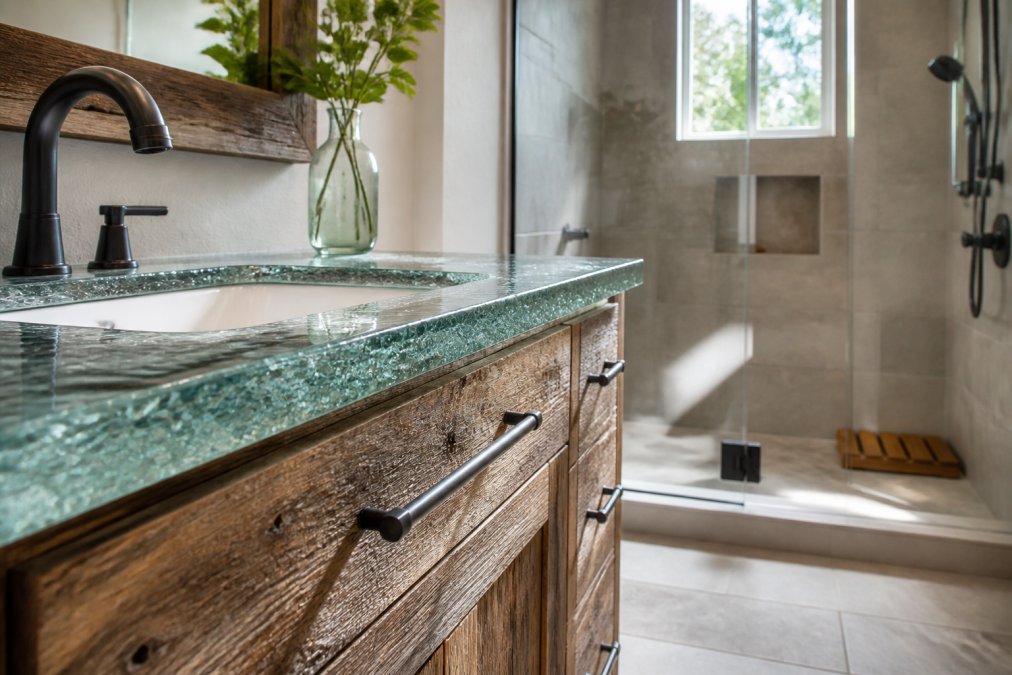
Reclaimed wood has a minimal lifecycle assessment: no trees are felled, no manufacturing energy is consumed, and no new chemicals are introduced. The trade-off is limited availability and higher cost.
Bamboo’s lifecycle assessment depends on sourcing and processing. Locally grown and manufactured bamboo carries a lower carbon footprint. Engineered bamboo requires adhesives that may off-gas volatile organic compounds; solid bamboo is cleaner but more expensive. Ask suppliers for Forest Stewardship Council (FSC) certification.
Cork flooring is water-resistant, antimicrobial, and renewable with a favorable lifecycle assessment. Its weakness is durability; it’s softer than tile or stone and can dent under heavy fixtures. Proper sealing extends its lifespan.
Recycled glass countertops and tiles repurpose waste, avoiding virgin resource extraction. Locally produced recycled glass carries a lower carbon footprint. It’s non-porous, stain-resistant, and available in many colors and finishes.
Ceramic and porcelain tiles have favorable lifecycle assessments. Ceramic is durable, lasting 20+ years with minimal maintenance. Locally manufactured tiles reduce transportation impact. Porcelain is denser and more durable, ideal for high-moisture bathrooms.
Natural stone has a mixed lifecycle assessment due to energy-intensive quarrying and transportation. However, its exceptional durability, 50+ years with proper care, spreads environmental cost over decades. Locally sourced or reclaimed stone reduces impact.
Microcement is a thin coating applied over existing surfaces, minimizing waste and demolition. It’s durable and water-resistant but requires skilled professional application.
Low-VOC paints and finishes are essential for indoor air quality. Traditional paints release harmful chemicals that linger for months. Low-VOC alternatives maintain color and durability without toxins. Look for Environmental Choice Program (ECP) certification or similar standards.
Prioritize durability and local sourcing. A material with a higher upfront cost but a 30-year lifespan is often more sustainable than cheaper options requiring replacement every 10 years. Ask suppliers for lifecycle assessment data and certifications (FSC, ECP, Cradle to Cradle).
Biophilic Design Elements and Wellness-Focused Layouts
Biophilic design brings natural elements into your bathroom, improving aesthetics and wellbeing. Living plants, natural light, and stone or wood textures create a spa-like sanctuary aligned with wellness-focused layouts.
Plants like pothos, ferns, and bamboo palms improve air quality. Natural stone tiles create a grounding element. Wood accents warm the environment and soften hard surfaces.
Maximize natural light to reduce artificial lighting. Skylights or light tubes introduce daylight without compromising privacy. Warm LED color temperatures support circadian rhythms.
A wellness-focused layout considers ergonomics and flow. Adequate counter space, accessible storage, heated floors, and proper ventilation transform a functional room into a personal retreat.
Smart Technology and Home Automation
Smart mirrors provide optimal lighting for grooming and control ventilation fans automatically based on humidity levels.
Smart shower systems preset water temperature and flow, eliminating waste. Some track water usage. Smart toilets with bidet functions reduce paper waste.
Motion-sensor lighting and smart exhaust fans that respond to humidity levels cut energy consumption and integrate with home automation platforms.
Focus on smart upgrades that solve real problems, such as humidity control, water tracking, and lighting efficiency, rather than adding unnecessary complexity.
Understanding Bathroom Remodel Cost and Timeline
Bathroom renovation costs vary by scope, materials, and complexity. Budget for labor, materials, permits, and contingencies for unexpected issues.
An eco-friendly bathroom renovation balances upfront costs with long-term savings. Water-saving fixtures and energy-efficient lighting pay for themselves within a few years. Sustainable materials cost more initially but last longer.
What to Expect in Your Bathroom Renovation Timeline
Most bathroom renovations take 2-4 weeks. A simple refresh takes 5-7 days. A full renovation takes longer. Bathroom Renovators typically completes projects in 7-10 days.
Unexpected issues discovered during demolition can extend timelines. Establish a contingency budget and timeline to manage surprises.
Permits and inspections add time. Source materials in advance to avoid supply-chain delays.
Retrofitting vs. Full Renovation: Which Approach Fits Your Needs
Retrofitting upgrades existing fixtures without major structural changes. It costs less, takes less time, and causes less disruption. It’s ideal for quick improvements without a full renovation commitment.
Full renovations remove and rebuild the bathroom, allowing layout redesign and addressing hidden problems. They cost more and take longer but create a completely fresh space.
Choose retrofitting if your bathroom functions well but looks dated. Choose full renovation if your layout is inefficient, plumbing is failing, or you want to integrate smart technology.
Retrofitting suits busy professionals needing minimal disruption. Full renovations suit long-term homeowners. Many choose a middle path, replacing key fixtures and adding one or two major upgrades.
Renovating your bathroom doesn’t have to mean months of chaos and mounting costs. By focusing on water-saving fixtures, sustainable materials, and smart design, you create a space that’s both beautiful and environmentally responsible. The challenge is coordinating the details, sourcing the right materials, managing timelines, and ensuring everything works together seamlessly. That’s where professional guidance makes the difference. Bathroom Renovators brings 19 years of experience renovating homes across the region, completing projects in 7-10 days with a 1-year warranty backing every detail. Get your free consultation today and discover how an eco-friendly bathroom renovation can transform your home without transforming your life into a construction site.
Frequently Asked Questions
What are the most cost-effective eco-friendly bathroom upgrades?
Low-flow showerheads, aerators, and LED lighting deliver the fastest return on investment. These upgrades reduce water and energy use immediately without requiring structural changes. Many homeowners pair these with low-VOC paint to improve indoor air quality. For specifics on your home’s potential savings and bathroom remodel cost, request a free consultation to assess your space.
How long does an eco-friendly bathroom renovation typically take?
A focused eco-friendly upgrade using energy efficient bathroom fixtures and water-saving elements typically takes 7-10 days for most homes. Full renovations with material replacement may extend longer. Your bathroom renovation timeline depends on scope: retrofitting existing plumbing is faster than rerouting systems. Discuss your specific needs to understand realistic timelines and avoid surprises.
Are sustainable bathroom materials more expensive than standard options?
Not always. Recycled glass and cork cost similarly to conventional materials, while reclaimed wood may cost more upfront but lasts longer, improving resale value. Bamboo cabinetry and microcement finishes offer mid-range pricing. Lifecycle assessment shows eco-materials often cost less over time due to durability and lower maintenance. Get a free quote to compare options for your specific bathroom remodel cost.
What’s the difference between retrofitting and a full bathroom renovation?
Retrofitting upgrades existing fixtures (installing low-flow showerheads, adding smart sensors, applying low-VOC paint) without structural changes. A full renovation replaces walls, plumbing, and flooring with sustainable materials. Retrofitting is faster and cheaper; full renovation offers deeper carbon footprint reduction. Your choice depends on your home’s condition, timeline, and budget. We help you decide which approach makes sense for your situation.
