
Table of Contents
- What $5000 Actually Covers in a Bathroom Renovation
- Average Cost of Bathroom Renovation: What Your $5000 Buys
- Material Costs: Where Your Budget Goes
- Labor vs. DIY: How to Save Without Cutting Corners
- Hidden Costs and How to Plan for Them
- Bathroom Renovation Timeline: What to Expect
- Hiring a Bathroom Contractor: What to Ask Before You Commit
- Resale Value and Return on Investment
- Conclusion: Is a $5000 Bathroom Renovation Right for You?
- Frequently Asked Questions
Last Updated: September 11, 2026
What $5000 Actually Covers in a Bathroom Renovation
Can I renovate my bathroom for $5000? Yes, it is realistic when you treat it as a targeted update rather than a full gut-and-rebuild. The catch is that you cannot renovate everything at once.
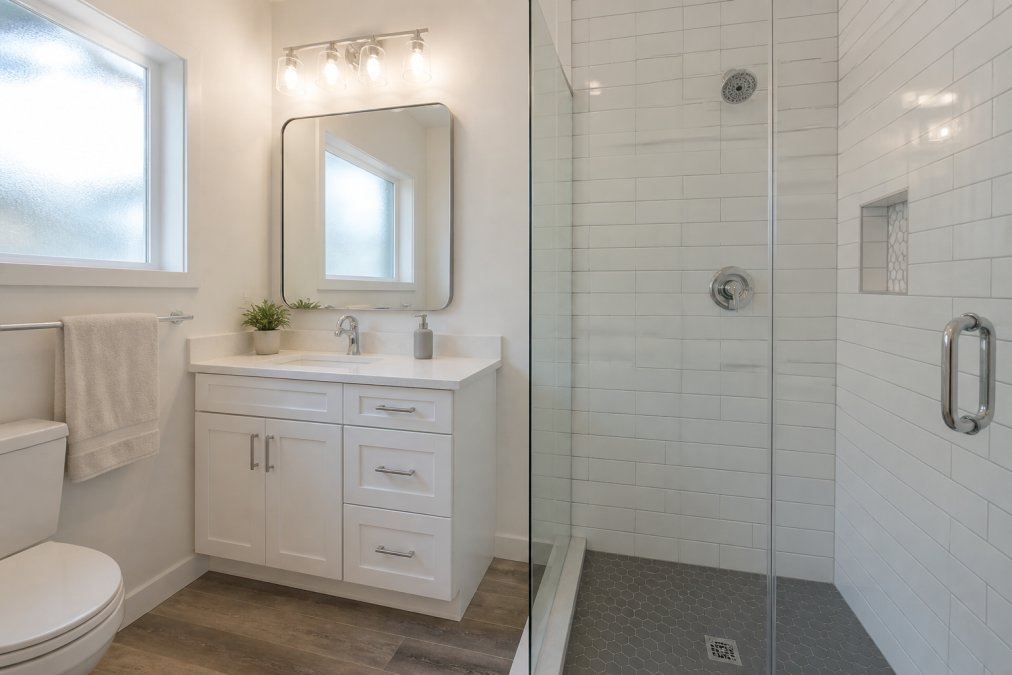
The budget works best when it targets the surfaces and fixtures people actually touch and see every day. Cosmetic updates like a vanity replacement, fresh tile installation, and new lighting fixtures deliver visible change without moving plumbing or tearing out walls. What it does not comfortably absorb is structural work: moving a drain, relocating a toilet, or rebuilding a subfloor after water damage.
Minor Refresh vs. Major Remodel: Where the Line Sits
A minor refresh keeps the existing footprint and plumbing layout. You replace finishes, fixtures, and hardware. A major remodel reconfigures the space, which means permits, demolition, and trades working in sequence.
The line between them is plumbing. The moment you move a drain or supply line, you’re into a major remodel, and $5000 stops being enough.
The Save vs. Splurge Framework for Tight Budgets
Spend on what you touch daily. Save on what you don’t.
- Splurge: faucets, shower valve, vanity, lighting
- Save: decorative tile accents, freestanding tubs, heated floors
- Skip entirely: layout changes, moving walls, adding a window
Most homeowners get this backwards, sinking money into a feature nobody notices and buying the cheapest faucet in the store.
Average Cost of Bathroom Renovation: What Your $5000 Buys
The average cost of a bathroom renovation varies widely by scope, and even more by how much you do yourself. A $5000 budget sits comfortably in the cosmetic-update tier, where the work is surface-level and the plumbing stays put.
Here’s how a realistic $5000 allocation tends to break down:
| Category | Typical Share | What It Covers |
|---|---|---|
| Materials | 40-50% | Tile, vanity, fixtures, paint |
| Labor | 30-40% | Installation, plumbing, electrical |
| Contingency | 10-15% | Surprises behind the walls |
That contingency line is not optional. A common mistake is spending the full budget on materials and then discovering the subfloor needs repair.
Material Costs: Where Your Budget Goes
Your materials list decides whether the project lands under budget or blows past it. Vanities, tile, and plumbing fixtures eat the largest share, and small choices compound fast. The trick is knowing which line items have the widest price spread so you can pull the right levers.
Here is how a $5000 budget typically splits across materials, with the realistic range for each line item:
| Line Item | Budget Range | Notes |
|---|---|---|
| Vanity + top | $400-$1,200 | Stock 30-36 in. units sit at the low end; custom or double-sink jumps fast |
| Faucet + shower valve | $150-$500 | This is the one place to spend up; daily-use hardware fails first when cheap |
| Tile (floor + shower) | $600-$1,500 | Material only; porcelain and ceramic are the budget workhorses |
| Toilet | $200-$600 | A standard two-piece is fine; comfort-height and dual-flush add cost |
| Lighting + exhaust fan | $150-$400 | A new fan is non-negotiable for moisture control |
| Paint + sundries | $100-$250 | Bathroom-rated paint, primer, caulk, tape, drop cloths |
| Hardware + mirror | $100-$300 | Cabinet pulls, towel bars, a framed mirror |
Those ranges assume a standard 5×8 or 5×9 bathroom. A larger room scales tile and paint upward but leaves fixtures roughly fixed.
Where the Money Actually Goes
The single biggest swing factor is tile. Floor and shower tile drive cost through both material and labor hours, and the difference between a basic ceramic and a large-format porcelain can double the line item. If you want to protect the budget, keep the tile simple and let the vanity and lighting carry the visual weight.
The second swing factor is the vanity. A stock unit from a big-box retailer costs a fraction of a custom build, and installation is straightforward because the dimensions are standardized. Custom vanities are where budgets quietly die.
High-Impact Upgrades That Cost Less
Grout refresh and surface refinishing are the two most underrated moves on a tight budget. A regrout makes old tile look new. Refinishing a tub or surround buys years of life without a replacement bill.
Hardware updates, new cabinet pulls, a mirror, and a towel bar, cost little and change the feel of the room. So does space planning: sometimes the best upgrade is simply removing clutter and improving storage.
If your tile is sound but the grout is stained, a professional regrout costs a fraction of retiling and delivers most of the visual improvement. Check for loose tiles first; regrouting over a failing substrate wastes the money.
The Save vs. Splurge Math
Run the numbers before you buy anything. If your materials total lands at $2,200 and you have $2,500 allocated, you have $300 of headroom. That headroom is your buffer against a mid-project surprise, not a reason to upgrade the faucet. Most homeowners who blow a $5000 budget do it by treating headroom as spending money in the first week.
A practical rule: lock your tile and vanity choices first, because they are the hardest to change later. Then buy fixtures and hardware, which are easy to swap and easy to return.
Labor vs. DIY: How to Save Without Cutting Corners
Labor is where budgets get rescued or wrecked. Doing the work yourself saves money on paper, but only if you finish it correctly and within a reasonable timeline.
Some tasks are genuinely DIY-friendly: demolition, painting, hardware installation, and waste disposal. Others are not. Electrical work and plumbing rough-in carry real risk, and in most jurisdictions require permits and licensed trades. The Canadian Electrical Code and provincial building codes set the rules, and skipping them can void insurance and stall a home sale.
The Hybrid Model: What to Do Yourself and What to Leave to a Pro
The hybrid model is the smartest path for most homeowners. You handle the labor-intensive, low-risk work and bring in a professional for anything regulated or technically demanding.
- Do yourself: demolition, hauling, painting, hardware, minor patching
- Hire out: electrical, plumbing rough-in, tile setting, waterproofing
- Never DIY: gas work, permit-required electrical, structural changes
This is where most guides miss the point. They frame it as all-or-nothing. In practice, the hybrid split often saves more than a full DIY attempt that has to be redone.
Waterproofing behind a shower is the single most common DIY failure point. If it’s done wrong, you won’t see the damage for months, and by then you’re paying for mold remediation and a full redo.
Hidden Costs and How to Plan for Them
The costs that break budgets are the ones you can’t see until demolition starts. Hidden structural issues, water damage, and outdated wiring surface once the walls are open.
Plan for them with a contingency fund of 10-15% of your total budget. If your budget is $5000, set aside $500 to $750 before you buy a single tile.
- Subfloor repair: rot or soft spots under old flooring
- Plumbing surprises: corroded pipes or non-compliant connections
- Electrical permits: bringing old wiring up to code
- Waste disposal: dumping fees add up with tile and old fixtures
Ask your contractor upfront how change orders are priced. A written cap on unexpected costs is reasonable to request.
Bathroom Renovation Timeline: What to Expect
A focused $5000 project typically runs one to three weeks, depending on how much you DIY and how quickly materials arrive. A full remodel with layout changes stretches much longer.
Here’s a realistic sequence:
- Planning and material selection: 1-2 weeks
- Demolition: 1-2 days
- Rough-in and repairs: 2-4 days
- Tile and waterproofing: 3-5 days
- Fixtures and finishing: 2-3 days
- Paint and cleanup: 1-2 days
Material procurement is the most common delay. Order tile and fixtures early, and confirm delivery dates before demolition begins.
Hiring a Bathroom Contractor: What to Ask Before You Commit
Hiring a bathroom contractor comes down to verifying three things: license, insurance, and references you can actually call. Contractor estimates should be itemized and in writing.
Ask these before you sign:
- Are you licensed and insured, and can I see proof?
- Can I speak with two recent clients?
- How are change orders priced, and is there a cap?
- Who pulls the permits, you or me?
- What does your warranty cover, and for how long?
Bathroom Renovators has over 26 years of experience renovating homes across Vancouver, North & West Vancouver, Burnaby, and Port Moody, completing projects in 7-10 days and backing the work with a one-year warranty. We provide free quotes, so you get a clear ballpark before committing to anything.
The thing nobody tells you about contractor estimates: the lowest bid is rarely the cheapest. It usually means something was left out, and you’ll pay for it later as a change order.
Resale Value and Return on Investment
Most guides stop at “a bathroom update protects equity.” That is not useful when you are deciding how to spend $5000. The real question is which version of a $5000 bathroom returns the most at resale, and the answer is not the one with the prettiest tile.
What Actually Recovers Cost
A bathroom renovation is one of the few home projects where a modest, well-executed update tends to recover a meaningful share of its cost at resale, while a luxury remodel often recovers less per dollar spent. The reason is simple: buyers and appraisers reward function and condition more than finishes. A clean, dry, code-compliant bathroom reads as “move-in ready.” A dated but functional one reads as “a project.”
That means the highest-return $5000 spend is not the one that looks the most dramatic. It is the one that removes the objections a buyer would otherwise raise.
The Objection-Removal Framework
Rank your spend by which buyer objections it eliminates:
- Moisture and mold concerns, a properly waterproofed shower and a working exhaust fan. This is the highest-return spend because it is the most expensive problem for a buyer to fix later.
- Outdated but functional fixtures, a new vanity, faucet, and lighting. Cheap to do, high visual impact, low risk.
- Cosmetic wear, grout refresh, fresh paint, new hardware. Low cost, lifts the whole room’s perceived condition.
- Trend-driven finishes, statement tile, freestanding tubs, heated floors. Lowest return per dollar in a $5000 budget because they date fastest and buyers rarely pay a premium for them.
If you are selling within a few years, spend down that list in order and stop when the budget runs out. If you are staying put for a decade, the calculus shifts toward what you will enjoy daily, and trend finishes become more defensible.
The Payback Reality Check
Be skeptical of any claim that a $5000 bathroom adds $5000 or more in equity. Renovation cost recovery varies by market, by how the home is priced, and by how the update compares to neighboring homes. A bathroom that is noticeably nicer than every other bathroom on the street may not appraise higher, because appraisers compare against the local norm, not against your taste.
The more reliable framing is this: a $5000 update rarely loses money at resale if it fixes condition and function, and it can shorten time on market because it removes the “needs work” label. That time-on-market effect is often worth more than the line-item cost recovery, and it is the part most homeowners overlook.
What to Skip If Resale Is the Goal
- Layout changes, expensive, permit-heavy, and rarely recovered in a $5000 budget.
- Niche luxury features, a freestanding tub in a small bathroom can actually hurt, because buyers see lost space.
- Bold, personal tile, it photographs well and appraises poorly.
If resale is your priority, spend your $5000 on waterproofing, a working exhaust fan, and a clean vanity-and-lighting refresh. Those three items remove the objections that cost buyers the most to fix, and they are the most likely to hold value regardless of what trends do next.
Conclusion: Is a $5000 Bathroom Renovation Right for You?
Can I renovate my bathroom for $5000? Yes, it is achievable when you stay inside the existing footprint, spend on the fixtures you use daily, and keep a contingency fund for what’s behind the walls. It won’t cover a layout change, but it will transform how the room looks and functions.
Bathroom Renovators works exclusively with homes across Vancouver, North & West Vancouver, Burnaby, and Port Moody, completing most projects in 7-10 days with a one-year warranty and free quotes. If you want a bathroom done right, on time, without surprises, get your free consultation and we’ll help you plan a scope that fits your budget.
Frequently Asked Questions
Can you remodel a small bathroom for $5000?
Yes, a small bathroom renovation for $5000 is possible if you focus on cosmetic updates rather than moving plumbing or changing the layout. Prioritize high-impact changes like a vanity replacement, new faucet upgrades, fresh paint, and a grout refresh. Keep existing fixtures where they work, choose mid-range materials, and handle some demolition yourself to save on labor. A $5000 budget covers a refresh, not a full gut job with structural changes.
What is a realistic budget for a bathroom renovation?
A realistic budget depends on scope. A minor refresh with new fixtures, paint, and hardware can fit within $5000. A mid-range remodel that includes tile installation, a new shower enclosure, and updated electrical typically costs more. A full renovation with layout changes, subfloor repair, and custom work runs higher still. The average cost of bathroom renovation varies by region, material choices, and whether you hire a contractor or do some work yourself.
How long does a bathroom renovation take?
A bathroom renovation timeline depends on the scope. A simple refresh with cosmetic updates can take 7-10 days with a professional team. A full remodel with plumbing or electrical changes may take several weeks. Factors like material procurement, permit approvals, and hidden structural issues can extend the timeline. Working with an experienced contractor who provides a clear schedule and communicates delays upfront helps keep the project on track.
What should I ask when hiring a bathroom contractor?
Ask about their timeline and how they handle delays, whether they provide a fixed quote or estimate, and what happens if they find hidden damage once work begins. Request recent references you can call, confirm they carry insurance and necessary permits, and ask about their warranty. A trustworthy contractor will give you a written scope of work, a payment schedule, and clear answers about extra costs before you sign anything.
