
Table of Contents
- How Long Does Bathroom Water Damage Repair Take?
- Water Damage Restoration Timeline: Phase by Phase
- What Slows Down Bathroom Water Damage Repair
- Minor vs. Major Water Damage: How Scope Changes the Timeline
- Signs of Mold After Water Damage (and How It Extends Repairs)
- Bathroom Vanity Installation Services: Why the Rebuild Phase Matters
- How to Speed Up Your Bathroom Water Damage Repair
- Conclusion
- Frequently Asked Questions
Last Updated: September 27, 2026
How Long Does Bathroom Water Damage Repair Take?
Most bathroom water damage repair takes 3 to 5 days for minor leaks and 2 to 6 weeks for major damage. The difference comes down to how far water traveled and whether mold has started. At Bathroom Renovators, we have handled these repairs across North Shore and Greater Vancouver for over 19 years, and the timeline almost always surprises homeowners. This guide breaks down each phase, what slows it down, and how to keep your bathroom water damage repair on schedule.
Canada Mortgage and Housing Corporation guidance on moisture and mold in the home
Quick Answer: Typical Timelines at a Glance
| Damage Level | Typical Timeline | Main Work Involved |
|---|---|---|
| Minor leak | 3-5 days | Water extraction, targeted drying, small drywall repair |
| Moderate damage | 1-2 weeks | Full drying, subfloor checks, partial rebuild |
| Major damage | 2-6 weeks | Structural drying, mold remediation, full reconstruction |
| Sewage contamination | 3-8 weeks | Emergency cleanup, sanitizing, replacement of porous materials |
The table above is a starting point, not a promise. Every bathroom is different.
Water Damage Restoration Timeline: Phase by Phase
A water damage restoration timeline moves through four phases: emergency response, water extraction, structural drying, and reconstruction. Skipping or rushing any phase causes callbacks later.
Here is how the phases usually run:
- Emergency response (same day): stop the water source, assess the damage
- Water extraction (hours 1-12): remove standing water with pumps and vacuums
- Structural drying (days 2-5): air movers and dehumidifiers pull moisture from materials
- Reconstruction (days 5+): drywall repair, tiling, vanity installation, finish carpentry
The drying phase is where most projects lose time.
Emergency Response and Water Extraction
Emergency water removal starts within hours of your call. A technician shuts off the supply, maps the moisture with thermal imaging, and begins water extraction. Standing water comes out fast. Water trapped in a subfloor or behind tile takes longer.
A common mistake is assuming a small puddle means a small problem. Water travels along joists and under flooring. What looks minor on the surface often hides water saturation below.
Structural Drying and Dehumidification
Structural drying is the process of removing moisture from building materials until they return to normal levels. Technicians use air movers, dehumidifiers, and hygrometers to track moisture content daily. Drywall usually dries in 2-3 days. Subfloor and framing can take 4-5 days or more. Without proper drying equipment, moisture stays trapped and mold follows.
What Slows Down Bathroom Water Damage Repair
Hidden moisture is the biggest cause of delays in bathroom water damage repair. When water sits behind walls or under a vanity, drying takes longer and repairs grow. But the delay itself is rarely one thing, it is a stack of small setbacks that compound. Here is what actually adds days to a job, and roughly how many.
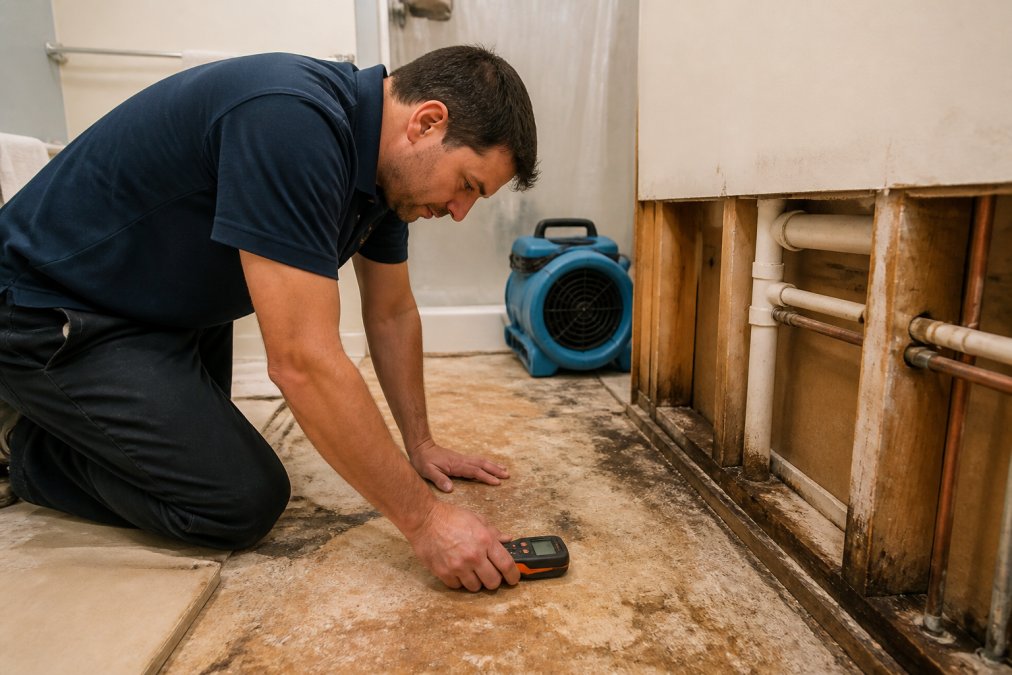
Late leak detection (adds 3-14+ days). A slow plumbing leak can run for weeks before you notice it. By the time a renovator opens the wall, the framing has been wet long enough that drying alone will not fix it, affected material has to come out. The longer the leak ran undetected, the deeper the rebuild goes.
Insurance claim processing (adds 2-10 days before work starts). This is the delay most homeowners do not see coming. An adjuster has to inspect, document, and approve the scope before a restoration crew can begin anything beyond emergency mitigation. If your policy requires a second adjuster visit, a proof-of-loss form, or a contractor estimate review, the clock pauses again. Filing the same day you discover the damage, with photos, a written timeline, and your policy number ready, is the single biggest lever you have over this delay.
Material drying times (adds 1-4 days). Tile, cement board, and thick subfloor hold water far longer than drywall. A wall of painted drywall might read dry in 48 hours; the same wall behind ceramic tile can take four to five days because the tile and thinset act as a vapor barrier. Vanity cabinets, especially particleboard or MDF, swell and delaminate rather than dry, so they usually get replaced instead of dried.
Sewage contamination (adds 3-7 days). Category 3 water requires full sanitizing and removal of all porous materials, drywall, insulation, and often subfloor sections.
Never start reconstruction while materials are still damp. Covering wet framing traps moisture and mold returns within months, usually behind your new tile.
The two delays you control are detection speed and documentation quality. Everything else, drying physics, mold remediation, inspection calendars, is largely out of your hands once the water is in the wall.
Minor vs. Major Water Damage: How Scope Changes the Timeline
Scope decides the schedule. A supply line leak that soaked one wall is a different job than a burst pipe that flooded the whole room.
Minor damage usually means:
- Clean water (category 1), caught within 24 hours
- One wall or a small floor area affected
- No mold, no structural damage
Major damage usually means:
- Contaminated water (category 2 or 3)
- Water under the subfloor or inside walls
- Visible mold or a musty smell
- Damage to cabinets, framing, or the ceiling below
Signs of Mold After Water Damage (and How It Extends Repairs)
Signs of mold after water damage include a musty odor, dark spots near baseboards, bubbling paint, and warped drywall. Mold can appear within 24 to 48 hours of a leak. When mold is present, the repair pauses. Remediation must remove affected materials and treat the area before any rebuild starts. That step alone can add 3 to 10 days.
Watch for these signs:
- A persistent musty smell that does not clear
- Dark or greenish patches on drywall or grout
- Soft, crumbly drywall near the floor
- Peeling paint or loose tile
- Family members with new allergy symptoms at home
Bathroom Vanity Installation Services: Why the Rebuild Phase Matters
Bathroom vanity installation services often sit at the end of the repair, but they shape how long the whole job feels. Once drying and any mold work are done, the rebuild begins: drywall repair, waterproofing, tiling, and fitting the new vanity. The rebuild is also where material-specific drying times decide whether you are waiting days or weeks, a detail most timelines skip.
How long each material actually takes to dry:
| Material | Typical Dry Time | Why |
|---|---|---|
| Painted drywall | 2-3 days | Porous, air moves through it |
| Drywall behind tile | 4-6 days | Tile and thinset block airflow |
| Plywood subfloor | 4-7 days | Thick, layered, slow to release moisture |
| OSB subfloor | 5-8 days | Swells and delaminates; often replaced |
| Cement board | 3-5 days | Absorbs water but releases it slowly |
| Vanity cabinet (solid wood) | 5-10 days | Dense grain holds moisture |
| Vanity cabinet (MDF/particleboard) | Usually replaced | Swells permanently; cannot be dried back |
Ask your contractor to confirm subfloor moisture readings before installing a vanity. A pin-type meter reading under 15% on wood framing is a good sign the floor is ready. If the reading is still climbing, the floor is not dry, no matter how it feels underfoot.
Material choice decides drying time, and drying time decides when the rebuild can start. If your vanity is MDF or particleboard and it got wet, budget for replacement, not drying.
How to Speed Up Your Bathroom Water Damage Repair
Speed comes from acting early and documenting everything. The faster water is removed and drying begins, the shorter the repair.
- Shut off the water and call a professional the same day
- Photograph all damage before anything is moved
- Contact your insurer right away and keep a claim log
- Clear the area so drying equipment can run
- Keep drying equipment running 24/7 until readings are normal
- Do not paint or tile over materials until they test dry
Conclusion
Bathroom water damage repair can run from a few days to several weeks, and the hidden moisture you cannot see is usually what decides which. Fast action, proper drying, and a contractor who checks moisture before rebuilding keep the timeline short and the results durable. Bathroom Renovators brings over 19 years of experience, projects completed in 7-10 days, custom designs, and a 1-year warranty to every repair and renovation.
Health Canada advice on mold and indoor air quality
Frequently Asked Questions
How long does water damage repair take in a bathroom?
Most bathroom water damage repairs take 3 days to 3 weeks. Category 1 clean water with a small leak might be resolved in 3 to 5 days. Category 2 or 3 water involving sewage contamination can push the timeline to 2 or 3 weeks once you include mold remediation, drywall repair, and reconstruction. The biggest variables are how long the water sat, how far it spread, and whether materials like the subfloor need full replacement.
How fast does mold start after water damage?
Mold can begin growing within 24 to 48 hours of water exposure in a warm, humid bathroom. Visible signs of mold after water damage include dark spotting on drywall, a musty odor, and bubbling paint. If you catch the leak within the first day and start structural drying immediately, you can often prevent mold from taking hold. Once mold is established, remediation adds several days to the repair timeline.
What are the steps involved in professional water damage restoration?
A typical restoration follows four phases. First, water damage assessment and leak detection using moisture mapping and thermal imaging. Second, water extraction with pumps and wet vacuums. Third, structural drying using air movers and dehumidifiers, which usually takes 3 to 5 days. Fourth, reconstruction, including drywall repair, subfloor replacement, and finish carpentry. Each phase adds to the total water damage restoration timeline.
Can a bathroom ceiling leak dry on its own?
A ceiling leak will not dry on its own in most cases. Water trapped above drywall keeps feeding moisture into the ceiling cavity, which raises the risk of mold and weakens the structural integrity of the joists. Surface moisture may appear to fade, but a hygrometer reading often shows high moisture content underneath. Professional water extraction and drying equipment are usually needed to dry the cavity fully.
