
Table of Contents
- Why Bathroom Mold Keeps Coming Back
- Signs of Toxic Mold in Bathroom You Should Never Ignore
- The Professional Mold Removal Process, Step by Step
- Mold Remediation Cost Canada: What You Are Actually Paying For
- DIY vs Professional Bathroom Mold Removal: The Real Trade-Off
- When Bathroom Mold Removal Is Worth It (and When It Is Not)
- Preventing Mold From Coming Back After Removal
- Frequently Asked Questions
Last Updated: September 25, 2026
Why Bathroom Mold Keeps Coming Back
Bathroom mold returns because the moisture source was never fixed. Cleaning visible growth removes the symptom, not the cause. Until ventilation, leaks, and surface saturation are addressed, spores settle back within weeks.
Signs of Toxic Mold in Bathroom You Should Never Ignore
Persistent musty odors, black or green patches near grout lines, and recurring allergic reactions separate a surface stain from a real problem. Any one warrants a closer look.
Watch for these indicators:
- Discoloration that returns after cleaning, especially in corners and behind the toilet
- A musty smell that lingers even when the room is dry
- Peeling paint or soft drywall near the shower or tub
- Respiratory irritation that eases when you leave the room
- Visible growth on caulk, grout, or ceiling tiles
The Professional Mold Removal Process, Step by Step
Professional remediation follows a fixed sequence: contain, remove, clean, dry, and verify. Skipping any stage is why DIY attempts fail.
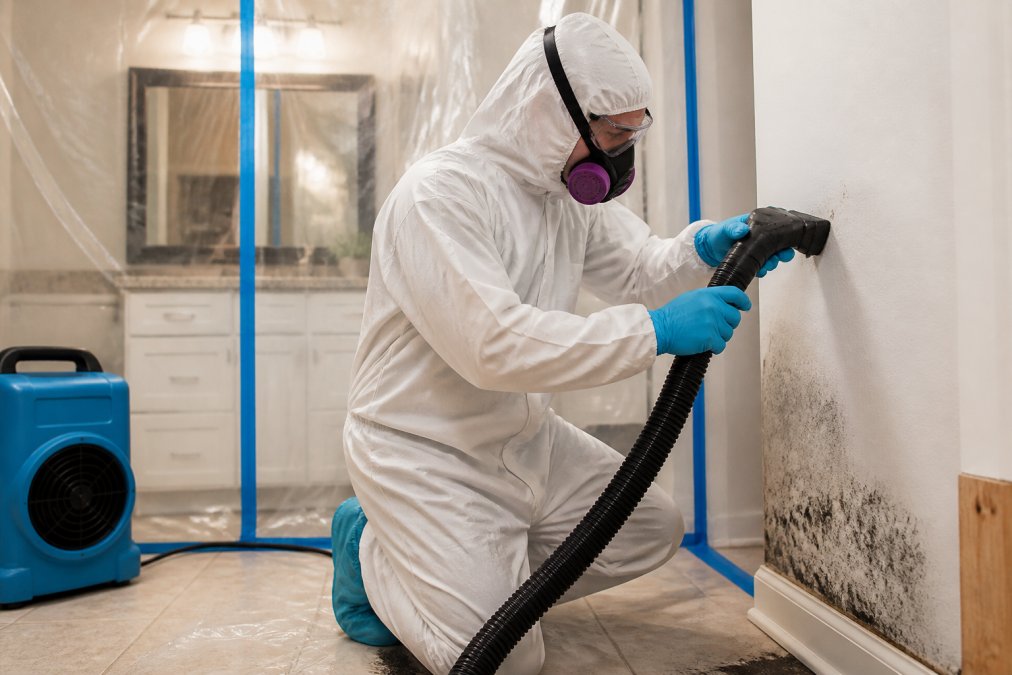
Here is what the process actually involves:
- Assessment and testing. A certified technician checks moisture levels, takes air and surface samples, and maps the growth.
- Containment. Plastic barriers and negative air pressure stop spores from spreading into the rest of your home.
- Removal. Porous materials such as saturated drywall and insulation are cut out and bagged; non-porous surfaces are scrubbed and treated with a biocide.
- HEPA filtration and drying. HEPA filtration captures airborne spores while dehumidification pulls moisture from the structure.
- Encapsulation and rebuild. Remaining structural material is sealed where appropriate, then the bathroom is rebuilt with moisture-resistant materials.
- Verification. Post-remediation testing confirms the spore count has returned to normal before handover.
Mold Remediation Cost Canada: What You Are Actually Paying For
Mold remediation cost depends on the affected area, how deep moisture has traveled, and whether rebuild work is needed. There is no single national figure, and any quote promising one without seeing your bathroom is guessing.
What drives the number:
- Square footage affected, including hidden growth behind walls
- Material replacement, since porous materials cannot be salvaged
- Testing and verification, including lab analysis of samples
- Rebuild scope, from new drywall to full tile and vanity replacement
- Access difficulty in small or awkward bathrooms
| Cost Driver | What Raises It | What Keeps It Lower |
|---|---|---|
| Affected area | Growth behind walls or under flooring | Surface growth only |
| Materials | Saturated drywall, insulation, wood | Tile and other non-porous surfaces |
| Testing | Multiple air and surface samples | Single confirmed area |
| Rebuild | Full tear-out and replacement | Clean-out and reseal |
| Access | Tight layouts, poor ventilation runs | Open, accessible layouts |
How the Number Actually Breaks Down
Most quotes bundle four separate jobs, and knowing which one you are paying for separates a fair price from an inflated one:
- Assessment and testing. Moisture mapping, air sampling, and lab analysis, a fixed diagnostic cost regardless of job size.
- Containment setup. Plastic sheeting, negative air machines, and HEPA filtration, largely fixed, so small and medium jobs often pay the same here.
- Removal and disposal. The variable cost, scaling with square footage and how much porous material must be cut out and bagged.
- Rebuild. Drywall, tile, vanity, and paint, frequently the largest line item, and the one homeowners forget to budget for.
The Insurance Question Nobody Answers
This is the biggest factor in whether remediation is ‘worth it’ out of pocket, and most guides skip it.
Homeowner policies typically split mold claims into two categories:
- Sudden and accidental, a burst pipe, an overflowing tub, a washing machine hose that fails. Mold that follows within a reasonable window is usually covered.
- Gradual or maintenance-related, a slow drip under the vanity, chronic condensation, a shower that has leaked for years. This is almost always excluded, because insurers treat it as neglect.
What that means in practice:
- If you can point to a single dated event, photograph it before cleanup begins, insurers deny claims where damage was altered before assessment.
- If mold has grown for months or years, assume it is not covered and plan accordingly.
- Read the mold sub-limit wording; many policies cover mold but cap it well below the main dwelling limit.
DIY vs Professional Bathroom Mold Removal: The Real Trade-Off
DIY works for small, surface-level growth on non-porous surfaces. It fails once mold moves into drywall, behind tile, or into the ventilation system, that is the real dividing line.
| Factor | DIY | Professional |
|---|---|---|
| Best for | Small surface patches | Growth behind walls or recurring mold |
| Containment | Limited, spores spread easily | Containment barriers and negative air pressure |
| Safety gear | Usually minimal | Full personal protective equipment |
| Drying | Household fans | Dehumidification and moisture meters |
| Verification | None | Post-remediation testing |
| Risk of return | High if moisture remains | Low when the source is fixed |
Cleaning mold with bleach on a porous surface is a common mistake. Bleach kills surface growth but does not reach into drywall or grout, and the moisture stays. The colony regrows deeper and often larger than before.
When Bathroom Mold Removal Is Worth It (and When It Is Not)
Professional removal is worth it when growth is recurring, larger than roughly a square meter, inside a wall cavity, or tied to a leak you cannot locate. It is not worth it for a small tile patch you can clean and dry completely.
Call a professional when:
- The mold returns after two or more cleaning attempts
- You can smell it but cannot see it
- The bathroom has had a leak, flood, or ongoing condensation problem
- Anyone in the home has mold-related health symptoms
- The growth is near the HVAC system or ventilation runs
Handle it yourself when:
- The patch is small and on a non-porous surface like tile or glass
- There is no musty odor and no history of leaks
- You can dry the area fully within a day
The Material Test: Where DIY Quietly Fails
The dividing line between DIY and professional is not patch size, it is what the mold is growing on.
- Tile, glass, glazed ceramic, and metal fixtures. Non-porous, surface growth can be cleaned, dried, and monitored. DIY is reasonable.
- Grout and caulk. Semi-porous, the surface cleans up, but the joint holds moisture. If the caulk line is discolored through its depth, cut it out and replace it, don’t scrub.
- Drywall and plaster. Porous, once mold reaches the paper facing, the section must be removed. Cleaning only removes what you can see.
- Vanity cabinets and wood trim. Porous and overlooked, particleboard and MDF wick moisture upward and hold it, so a cabinet that looks fine outside can be colonized behind the toe kick.
- Insulation and subfloor. Porous and hidden, this is where ‘it came back’ stories originate.
The Step That Proves It Worked
Most homeowners have never heard of post-remediation verification, the only objective proof the job is done.
Why this matters for the ‘worth it’ question:
- Without verification, you pay for a visual result, not a confirmed one.
- If growth returns, you have no baseline to prove whether the original job was incomplete or a new moisture event occurred.
- Verification separates remediation from cleaning: cleaning makes the room look better, remediation makes the air measurably normal.
The Insurance Angle
Many policies cover mold remediation from a sudden, covered event such as a burst pipe, but exclude mold from long-term neglect or poor maintenance. Read your policy wording before assuming either way, and photograph the damage before work begins. If the cause is gradual, chronic condensation, a slow leak, assume it is not covered and factor that in.
Preventing Mold From Coming Back After Removal
Prevention is moisture control: remove the water, move the air, keep surfaces dry. Without those three, even perfect remediation will not hold.
Practical steps:
- Run the exhaust fan during and for at least 20 minutes after every shower
- Fix leaks immediately, including slow drips under the vanity
- Keep a hygrometer in the room and aim to hold humidity below 50 percent
- Wipe down walls and shower surrounds after use
- Reseal grout and caulk annually
- Leave the door or a window open when the room is not in use
A hygrometer costs very little and tells you more about your mold risk than any visual inspection. If the reading sits above 60 percent for days at a time, you have a ventilation problem worth solving before mold appears.
Frequently Asked Questions
Should black mold be professionally removed?
Black mold that covers more than a square metre, sits behind tiles or under flooring, or keeps returning after you clean it should be professionally removed. At that scale, spores have likely spread through the room and into porous materials like drywall and grout, which household sprays cannot reach. A certified technician can identify the moisture source, contain the area, and verify the space is clean afterward. If anyone in the home has asthma or allergies, professional bathroom mold removal is the safer route.
How much does it cost to remove black mold from a bathroom?
Mold remediation cost Canada varies widely depending on the size of the affected area, whether materials like drywall or tile need removing, and whether the moisture source is a simple leak or a larger water damage problem. Because every bathroom is different, a reliable provider will assess the space before quoting. For an accurate figure, request a free inspection and written estimate rather than relying on generic online ranges.
What actually kills bathroom mold?
Killing mold on a non-porous surface like glazed tile or glass is straightforward with a proper cleaner, but killing it inside drywall, grout, or silicone is a different problem. Those porous materials hold moisture and spores that surface sprays cannot reach, so the mold often returns within weeks. Effective remediation means removing contaminated porous materials, drying the structure with dehumidification and HEPA filtration, and fixing the moisture source. Without moisture control, no product keeps mold away for long.
Can I paint over bathroom mold?
No. Painting over mold traps it under the coating, and the moisture that fed it is still in the wall. The mold continues to grow behind the paint, eventually blistering or peeling the surface, and the spore count in the room keeps rising. Even mold-resistant paint only works on a clean, dry, mold-free surface. If you see staining on a ceiling or wall, the mold is usually deeper than the paint layer, and that section of drywall often needs to be removed and replaced.
