
Table of Contents
- Start With a Neutral, Soothing Color Palette
- Spa Bathroom Lighting Ideas That Set the Mood
- Upgrade Fixtures: Rain Showerheads and Freestanding Tubs
- Bathroom Tile Trends 2026: Natural Stone, Marble, and Wood Accents
- Best Bathroom Plants for Humidity
- Declutter and Add Minimalist Storage
- Layer Textiles and Sensory Details for a Spa Retreat
- Frequently Asked Questions
Last Updated: September 12, 2026
Start With a Neutral, Soothing Color Palette
The fastest way to shift a bathroom from functional to restorative is color. A neutral palette built on warm whites, soft greys, sand, and muted stone tones lowers visual noise and lets the room read as calm rather than clinical. This guide walks through seven changes, ranked by effort and cost, so you can build a spa bathroom at home without gutting the room.
Here’s what most guides get wrong: they treat color as a paint decision. It isn’t. In a small bathroom, color is a lighting decision. A warm grey that looks serene under a cool bulb turns dingy and flat. Choose your palette, then match the bulb temperature to it, not the other way around.
A few rules that hold up in practice:
- Pick one base tone and stay within two shades of it across walls, tile, and vanity
- Avoid pure white on every surface; it reads as hospital, not spa
- Add depth with a single darker accent, such as a charcoal or walnut detail
- Test paint on the actual wall, in the actual light, for two days before committing
A spa bathroom is a room designed to calm the senses through color, light, texture, and sound working together, not a collection of expensive fixtures. That definition matters because it tells you where to spend: atmosphere first, hardware second.
Paint a sample patch beside the mirror, not on a bare wall. Mirror lighting bounces back and changes how the color reads from every angle in the room.
Spa Bathroom Lighting Ideas That Set the Mood
The single highest-impact change in any bathroom is dimmable, layered lighting. Overhead light alone flattens a room. Three layers, on separate switches or dimmers, transform it.
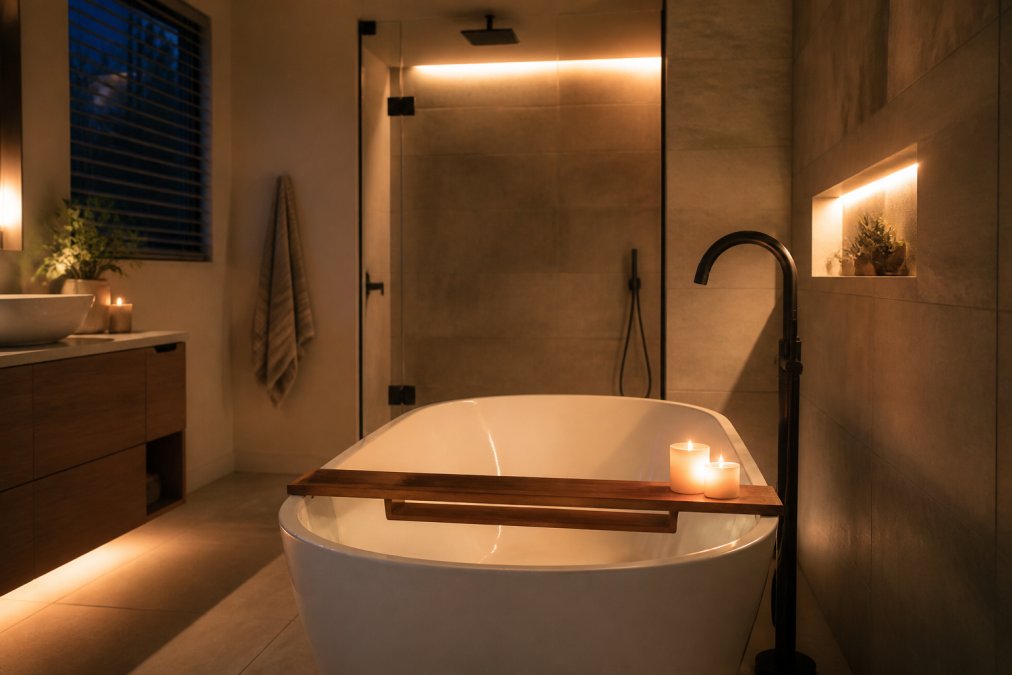
Build the layers like this:
- Ambient: a dimmable ceiling fixture at roughly 2700K to 3000K, warm enough to relax under
- Task: vertical sconces on either side of the mirror at eye level, which eliminate the shadows overhead fixtures cast on your face
- Accent: a small LED strip behind the vanity or under a floating shelf for a soft glow near the floor
Dimmers are the non-negotiable part. A single dimmable circuit costs little and changes how the room feels at 7 a.m. versus 9 p.m. For more detailed guidance on fixture placement and layering, the Canada Mortgage and Housing Corporation’s renovation guidance is a useful starting reference.
One honest limitation: sconces require wiring, and in a bathroom with tile already in place, running new cable means opening the wall. If you’re not renovating, plug-in sconces and battery LED strips get you most of the effect.
Upgrade Fixtures: Rain Showerheads and Freestanding Tubs
Fixtures deliver the most sensory change per dollar. A rain showerhead turns a five-minute rinse into something you linger under, and it’s a straightforward swap in most showers. A freestanding tub is the bigger commitment, and it’s where most budgets go sideways.
| Upgrade | Effort | Best For | Watch Out For |
|---|---|---|---|
| Rain showerhead | Low | Nearly every shower | Needs adequate water pressure |
| Handheld + rain combo | Low | Families, accessible use | Mounting height |
| Freestanding tub | High | Larger bathrooms, wet rooms | Floor support, drain relocation |
| Wet room conversion | High | Small rooms, open feel | Full waterproofing required |
A wet room, where the shower area is open and fully tanked rather than enclosed in a tray, is the design move that makes small bathrooms feel larger. It also fails spectacularly if the waterproofing is rushed. Water finds every gap, and in a wet room those gaps are behind the tile.
Rain showerheads need roughly 2.5 bar of pressure to perform well (cmhc-schl.gc.ca). Test your pressure before buying, or you’ll replace a beautiful fixture with a disappointing drizzle.
Bathroom Tile Trends 2026: Natural Stone, Marble, and Wood Accents
Natural materials carry the spa look better than anything synthetic, but the material you choose is also the material you’ll be cleaning for the next decade. That trade-off is where most trend roundups stop short.
This year’s direction favors large-format stone-look tile, honed marble, and warm wood accents that break up hard surfaces. The shift is toward texture you want to touch, not high-gloss finishes that photograph well and feel cold underfoot.
What’s changing in 2026: matte and honed finishes are replacing polished tile almost everywhere except small accent areas, and slab-style formats with minimal grout lines are winning over mosaic patterns. Fewer grout lines means less scrubbing and a calmer visual field, a maintenance win disguised as an aesthetic one.
- Natural stone and stone-look porcelain: limestone, travertine, and slate tones for floors and shower walls
- Marble: honed rather than polished, used as a vanity backsplash or single feature wall
- Wood accents: teak or cedar for a bench, shelf, or bath caddy, not for wet-floor areas
- Grout: match it to the tile rather than contrasting it, unless you want a graphic look
The maintenance reality nobody puts in the trend post
In a humid bathroom, material choice is a durability question as much as an aesthetic one. Porous stone, travertine, limestone, and unfilled marble in particular, absorbs water and soap scum, and once it’s stained, the stain sits below the surface where no sponge can reach it. Sealing slows that down but doesn’t stop it. A common pattern is to seal on installation, then re-seal every 12 to 18 months, with more frequent sealing in a heavily used shower.
If you’d rather not maintain it, stone-look porcelain gives the same appearance with far less upkeep. Porcelain is vitrified, meaning its water absorption is close to zero, so it doesn’t need sealing at all. The trade-off is that it can read slightly flatter than real stone in raking light, a difference most people only notice in photographs.
Grout is the other long-term variable. Cementitious grout is porous and stains; epoxy grout resists staining and mold but costs more and is less forgiving to install. In a shower, epoxy grout is the choice that ages best. On a floor, standard grout with a quality sealer is usually enough.
Skip polished marble on shower floors. It’s slippery when wet, and the polished surface shows every water spot and etch mark from acidic cleaners. Honed or brushed finishes are safer and more forgiving.
Ventilation is the material’s best friend
No tile choice survives a bathroom that stays wet. Run the exhaust fan during every shower and for 15 to 20 minutes after, and leave the door or a window open when you can (canada.ca). A squeegee on the shower walls takes 20 seconds and removes the standing water that feeds both mold and mineral staining. These habits cost nothing and extend the life of every surface in the room, stone, grout, and wood alike.
Pick the finish for how it will look in year five, not week one. Honed porcelain with epoxy grout in the shower and a sealed stone-look floor elsewhere gives you the spa look with the least ongoing work.
Best Bathroom Plants for Humidity
The best bathroom plants for humidity are tropical varieties that thrive in moist air: pothos, snake plant, ZZ plant, Boston fern, and peace lily. These tolerate the steam and low light typical of bathrooms better than desert plants, which rot in humid conditions.
Where people go wrong is placement. A plant directly beside the shower gets constantly soaked, and constant soaking kills most of them just as fast as drought. Position plants a metre or so from the shower, on a shelf or windowsill, where they catch ambient humidity without direct spray.
- Pothos: tolerates low light, trails nicely from a shelf
- Snake plant: handles neglect and low light, needs very little water
- Boston fern: loves humidity, needs brighter indirect light
- ZZ plant: forgiving, works in windowless bathrooms with occasional rotation
If your bathroom has no window at all, rotate plants out every week or two so they can recover in brighter light elsewhere. Greenery is one of the cheapest ways to make a room feel alive, and it’s also one of the easiest things to get wrong by overwatering.
Declutter and Add Minimalist Storage
Clutter is the enemy of calm. A spa bathroom reads as serene because there’s nothing on the counter competing for attention. The fix isn’t more storage, it’s less visible stuff.
Start by emptying every surface completely, then add back only what you use daily. Everything else goes into a drawer, a cabinet, or out of the room. Then solve storage with intent:
- Vanity organization: dividers and shallow drawers so items sit in one layer, not stacked
- Floating shelves: one or two, holding a single tray of items rather than a row of bottles
- A bath caddy: keeps tub-side items contained and removable
- Hidden bins: a lidded basket for towels or laundry, so the room never looks mid-use
The rule that works: if it isn’t beautiful or used daily, it doesn’t live on the counter. Decanting shampoo and soap into matching amber or ceramic bottles is a small change that removes the visual noise of mismatched packaging.
Decluttering is the cheapest renovation you’ll ever do. Empty every surface, then add back only daily-use items. The room will feel larger and calmer before you spend anything.
Layer Textiles and Sensory Details for a Spa Retreat
Sight is only one sense, and this is where most spa bathroom guides stop short. A spa retreat engages smell, sound, touch, and temperature, and the last two are the ones people actually remember. The good news is that these layers cost far less than tile and fixtures, and almost all of them are renter-friendly.
Smell: scent with an off switch
Aromatherapy works through a diffuser or a few drops of essential oil on a cotton pad placed near the vent, so the air movement carries it without you sitting in a cloud of it. Lavender and eucalyptus are the workhorses. Keep it subtle, a scent you can’t escape becomes a headache, and in a small bathroom the threshold is lower than you think. If you rent and can’t mount anything, a reed diffuser on a shelf does the same job with no power and no residue.
Sound: design the silence
Sound is the most overlooked layer. A small waterproof speaker is the obvious move, but the bigger win is removing noise you didn’t choose. A rattling exhaust fan, a dripping tap, or a toilet that runs for 30 seconds after every flush all undercut the calm more than any decor choice can fix. Silence is a design feature, and it’s usually free to restore.
Touch: what your feet and skin register
Plush towels and a thick bath mat change how the room feels underfoot and against skin. Two good towels beat six thin ones, thin towels feel institutional no matter how neatly they’re folded. Look for long-staple cotton or bamboo, and wash new towels once before first use to remove the sizing that makes them feel stiff. A robe on a hook within reach of the shower is a small addition that makes the whole routine feel deliberate.
Temperature and humidity: the layer that makes it feel like a spa
A heated towel rail or a well-placed rug so bare feet never hit cold tile is the touch layer most guides mention. The humidity layer is the one they skip. A bathroom that stays steamy for an hour after a shower feels damp, not spa-like. Running the exhaust fan during and after every shower, and leaving the door open afterward, keeps the room in the comfortable range rather than the swampy one. If your bathroom has no fan, a small plug-in dehumidifier is a renter-friendly fix that also protects the finishes you just invested in.
- Swap thin towels for plush long-staple cotton or bamboo
- Add a thick, quick-drying bath mat
- Keep a candle or diffuser on the bath caddy
- Store a robe and slippers within arm’s reach of the tub
- Run the fan during and after every shower to control humidity
The renter-friendly version
None of this requires a renovation, and none of it requires drilling. Plug-in sconces, battery LED strips, a freestanding towel ladder, a suction-mounted caddy, and a plug-in dehumidifier cover the light, storage, and humidity layers without touching the walls. Everything here is reversible if you move, which is exactly why it’s the layer worth doing first, you get most of the spa feeling for a fraction of the cost, and you learn what you actually use before committing to a remodel.
Start with the reversible layers: scent, sound, textiles, and humidity control. They cost the least, they work in a rental, and they’re what makes a good bathroom feel like a retreat.
Frequently Asked Questions
How can I create a spa bathroom on a budget?
Focus on small changes that make a big sensory impact. Swap harsh bulbs for dimmable warm lighting, add plush towels and a teak bath mat, and bring in a humidity-loving plant like a snake plant. Decluttering your vanity and using matching containers costs little but instantly reduces visual noise. For a bigger change, updating your showerhead to a rain style is a straightforward upgrade.
What are the essential elements of a spa-inspired bathroom?
A spa bathroom typically combines a neutral palette, layered ambient lighting, natural materials like stone or wood, and thoughtful textures. Freestanding tubs and rain showerheads add luxury, while greenery and plush textiles soften the space. The goal is a calm, uncluttered environment that engages sight, touch, and smell, turning your daily routine into a retreat.
How do I choose the right lighting for a spa-like atmosphere?
Use dimmable fixtures on separate circuits so you can adjust brightness. Combine ambient light from wall sconces or cove lighting with task lighting near the mirror. Warm color temperatures around 2700K to 3000K create a soft glow. Avoid harsh overhead lights; instead, layer candles or LED strips for a calming, spa bathroom feel.
What materials are best for a luxury spa bathroom aesthetic?
Natural stone like marble or travertine, wood accents, and matte ceramics work well. For tile, large-format porcelain that mimics stone reduces grout lines for a seamless look. Teak or bamboo adds warmth and handles moisture. Pair these with plush cotton or bamboo towels and a teak bath caddy to complete the spa bathroom retreat.
