
Table of Contents
- What to Look for in Bathroom Renovation Contractors
- Questions to Ask Bathroom Contractors Before You Hire
- Average Cost of Bathroom Renovation: What Drives the Budget
- Bathroom Renovation Timeline: From First Call to Final Walkthrough
- Bathroom Renovation Contract Template: What Must Be in Writing
- Common Renovation Pitfalls and How to Avoid Them
- ROI and Property Value: Why a Quality Bathroom Renovation Pays Off
- Step-by-Step Checklist for Hiring Bathroom Renovation Contractors Near You
- Frequently Asked Questions
Last Updated: August 27, 2026
Finding reliable bathroom renovation contractors near me is harder than it should be. Most homeowners have heard the horror stories: contractors who vanish mid-project, budgets that double without warning, and bathrooms left unusable for weeks. At Bathroom Renovators, we’ve spent over 26 years working through exactly these problems, and this guide gives you a clear framework to vet contractors, understand costs, and protect yourself before a single tile is removed.
What to Look for in Bathroom Renovation Contractors
The biggest mistake homeowners make is treating price as the primary filter. A low quote from an unqualified contractor will almost always cost more in the end through rework, water damage, or failed inspections.
Bathroom renovation contractors worth hiring hold a valid contractor licence, carry liability insurance and WorkSafeBC coverage, and can show you a portfolio of completed projects with verifiable references.

Licensing, Insurance, and WorkSafeBC Coverage
Licensing is formal authorization from a municipality or provincial body confirming a contractor meets minimum competency standards. In British Columbia, contractors undertaking structural, plumbing, or electrical work must hold appropriate trade licences under the BC Building Code, and work typically requires building permits from the local municipality.
Before signing anything, ask for:
- Their BC contractor registration number or relevant trade certification
- Proof of general liability insurance (minimum $2 million coverage is standard)
- A current WorkSafeBC clearance letter confirming premiums are paid
The WorkSafeBC employer registration and clearance letter information lets you verify a contractor’s standing directly. If a contractor hesitates to provide this documentation, that’s your answer.
Verifying Experience and Specialization
General renovation experience is not the same as bathroom specialization. Bathrooms involve waterproofing, ventilation systems, plumbing fixtures, tile work, and moisture-resistant materials in a small, complex space.
Ask how many bathroom renovations they’ve completed in the past 12 months specifically. Request references from recent projects, not years ago. Check Google reviews and call two or three homeowners who’ve been through the process, they’ll tell you things no website ever will.
Ask the contractor to walk you through a recent project from initial consultation to final walkthrough. How they describe the process, complications that arose, communication with the homeowner, and how they handled unexpected findings tells you far more than a polished portfolio.
Questions to Ask Bathroom Contractors Before You Hire
Work through qualification, process, and protection questions before you commit.
Qualification questions:
- Are you licensed for plumbing and electrical work, or do you subcontract those trades? If subcontracting, are those subcontractors also licensed and insured?
- Can you pull the required building permits, and is permit cost included in your quote?
- How many bathroom renovations have you completed in the past year?
Process questions:
- What is your realistic timeline for a project of this scope, and what factors could extend it?
- How do you handle unexpected findings, such as water damage or mold behind walls, once demolition begins?
- Who will be on site each day, and will I have a single point of contact throughout the project?
Protection questions:
- What warranty do you provide on labour and materials?
- What does your payment schedule look like, and do you require a large deposit upfront?
- Can I see a sample contract before I sign?
A contractor who answers these questions directly and confidently has nothing to hide. Vague answers or pressure to sign quickly are red flags.
Average Cost of Bathroom Renovation: What Drives the Budget
The average cost of a bathroom renovation varies widely based on scope, materials, and your home’s specific conditions. The most accurate approach is to get itemized quotes from at least two or three contractors and compare them line by line. Bathroom Renovators provides free quotes so you understand what your specific project involves before committing.
Key variables that drive renovation budgets include:
- Scope of plumbing work: Moving drain lines or supply pipes significantly increases cost versus replacing fixtures in existing locations
- Tile and flooring installation: Material choice, tile size, and pattern complexity affect both material cost and labour time
- Vanity and cabinetry: Custom cabinetry costs considerably more than stock units but offers better space use in unusual layouts
- Shower renovation type: Tiled custom showers cost more than prefabricated units but hold up better in high-humidity environments
- Lighting design and ventilation systems: Proper ventilation prevents long-term moisture damage in Vancouver’s climate
Where Costs Commonly Exceed Early Estimates
The area where renovation budgets most often balloon is hidden damage discovered during demolition. Water damage behind shower walls, subfloor rot, or inadequate waterproofing can add significant cost once walls are open.
A reputable contractor will include a contingency discussion in your initial consultation. Ask directly: “What happens if you find damage once you start? How is that communicated to me, and how are additional costs approved?” According to the Canada Mortgage and Housing Corporation’s guide to home renovation planning, planning for a contingency of 10-15% above your base budget is standard practice for renovation projects involving structural or plumbing work.
Bathroom Renovation Timeline: From First Call to Final Walkthrough
A bathroom renovation timeline from first consultation to completed project typically runs 3-6 weeks when you account for design, permitting, material procurement, and construction. The construction phase itself runs 7-10 days with an organized contractor.
Here’s how a well-managed project unfolds:
- Initial consultation and design: 1-2 meetings to assess the space and finalize material selections
- Permit application: Building permits typically take 5-15 business days through most Metro Vancouver municipalities
- Material procurement: Tile, fixtures, vanity, and cabinetry ordered and confirmed
- Demolition and rough-in: Existing fixtures removed, plumbing and electrical rough-in completed and inspected
- Waterproofing and drywall: Critical stage; proper waterproofing prevents future water damage
- Tile work and flooring installation: The most visible phase; quality here determines the long-term look
- Fixture installation: Vanity, toilet, shower fixtures, lighting, and cabinetry installed
- Final inspection and walkthrough: Contractor walks you through completed work; deficiencies addressed before final payment
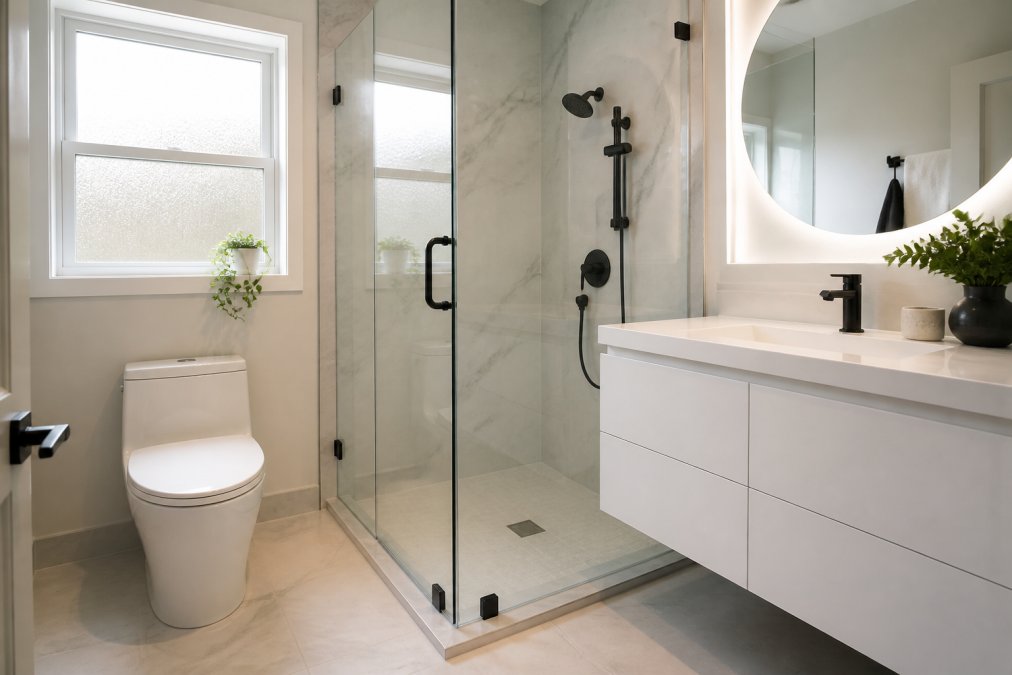
The most common timeline killer is material availability. If your contractor starts demolition before all materials are confirmed on-site, you risk your bathroom being out of commission for weeks while waiting on back-ordered items. Confirm materials are staged before demolition begins.
Bathroom Renovation Contract Template: What Must Be in Writing
A bathroom renovation contract must cover every aspect of the project in writing before work begins. Verbal agreements are unenforceable and almost always lead to disputes.
Every contract must include:
- Full scope of work: Detailed description of every task, including which trades are involved
- Materials specification: Brand, model, colour, and quantity of every material, tile, fixtures, vanity, grout, waterproofing membrane
- Project timeline: Start date, estimated completion date, and milestone dates for key phases
- Payment schedule: Total price, deposit amount, progress payment triggers, and final payment conditions. Never pay more than 10-15% as a deposit.
- Change order process: How changes to scope are documented, priced, and approved in writing before work proceeds
- Permit responsibility: Which party is responsible for obtaining and paying for building permits
- Warranty terms: What is covered, for how long, and the process for making a warranty claim
- Dispute resolution: How disagreements are handled if they arise
The Consumer Protection BC guidance on contractor agreements provides additional context on your rights as a homeowner.
Common Renovation Pitfalls and How to Avoid Them
Most renovation nightmares follow a predictable pattern. Recognizing warning signs early saves you from becoming a cautionary tale.
Choosing on price alone. The lowest quote is rarely the best value. An unusually low bid often means the contractor has underestimated scope, plans to cut corners on materials, or will hit you with change orders once work is underway.
Skipping the permit process. Unpermitted plumbing and electrical work creates problems when you sell the property. Insurers can deny claims for damage resulting from unpermitted work.
No written change order process. Scope changes happen in almost every renovation. Without a signed change order before additional work begins, you have no protection against inflated charges.
Paying too much upfront. A large deposit before work begins removes your leverage if the contractor underperforms. A reasonable deposit covers material procurement; the bulk of payment should follow completed milestones.
Ignoring ventilation. Bathrooms without adequate ventilation develop mold within months. Proper ventilation is not optional; it’s a structural requirement of a well-executed bathroom renovation.
The single most reliable predictor of a smooth renovation is how a contractor handles your questions before you hire them. Transparency, specificity, and a willingness to put everything in writing are the marks of a contractor who delivers.
ROI and Property Value: Why a Quality Bathroom Renovation Pays Off
A well-executed bathroom renovation is one of the highest-ROI home improvement projects available. Updated bathrooms rank among the top factors buyers evaluate, particularly in competitive markets.
According to the Appraisal Institute of Canada’s guidance on renovation value, mid-range bathroom renovations typically recover a meaningful percentage of their cost at resale, with higher recovery rates in strong housing markets.
Sustainable and Eco-Friendly Upgrades Worth Considering
Sustainable upgrades have moved from niche preference to mainstream expectation, and many reduce ongoing utility costs while improving the renovation’s long-term value.
Worth including in your renovation budget:
- Low-flow toilets and showerheads: Certified by the WaterSense program, these fixtures reduce water consumption without sacrificing performance
- LED lighting: Lower energy draw, longer lifespan, and better light quality than older fixtures
- Proper ventilation with heat recovery: Heat recovery ventilators maintain air quality while recapturing warmth, reducing heating costs
- Durable, low-maintenance materials: Porcelain tile, solid-surface countertops, and quality plumbing fixtures that last 20+ years reduce the frequency of future renovations
Sustainable choices are good for the environment and the budget over a 10-year horizon, and increasingly factored into property valuations.
Step-by-Step Checklist for Hiring Bathroom Renovation Contractors Near You
Use this checklist before signing any agreement with bathroom renovation contractors.
Research phase:
- Search for bathroom renovation contractors with verified Google reviews and recent project photos
- Confirm the contractor specializes in bathrooms, not general renovation work
- Check that the contractor operates in your municipality and is familiar with local permit requirements
Vetting phase:
- Request proof of BC contractor licence and relevant trade certifications
- Obtain a WorkSafeBC clearance letter
- Verify general liability insurance (minimum $2 million)
- Ask for three references from projects completed in the past 12-18 months and call them
Quoting phase:
- Get itemized quotes from at least two contractors
- Confirm whether building permits are included in the quote
- Ask how unexpected findings are handled and priced
- Clarify the payment schedule and confirm the deposit is reasonable
Contract phase:
- Confirm all materials are specified by brand, model, and colour in the contract
- Verify the timeline, start date, and completion date are written in
- Confirm the change order process requires written approval before additional work proceeds
- Review the warranty terms, what’s covered, for how long, and how to claim
Pre-construction phase:
- Confirm all materials are on-site or confirmed for delivery before demolition begins
- Establish a daily communication protocol with your site contact
- Clarify how the rest of your home will be protected from dust and debris
Bathroom Renovators completes most bathroom renovations in 7-10 days, backs every project with a 1-year warranty, and provides free quotes so you can work through this checklist with a contractor who has nothing to hide.
Bathroom renovations go wrong most often because homeowners hire on price and hope for the best. The contractors worth hiring are transparent about their process, put everything in writing, and have a track record of recent projects you can verify. Bathroom Renovators brings over 26 years of bathroom specialization, a 7-10 day project timeline, and a 1-year warranty on every renovation. Get your free consultation with Bathroom Renovators and know exactly what your renovation involves before any work begins.
Frequently Asked Questions
How do I verify if a bathroom contractor is licensed and insured?
Ask for their BC business license number, proof of liability insurance, and confirmation of WorkSafeBC coverage before signing anything. You can verify WorkSafeBC clearance letters directly through the WorkSafeBC website. A reputable contractor will provide these documents without hesitation. If a contractor deflects or says paperwork is ‘in the mail,’ treat that as a red flag and move on to the next quote.
How long does a typical bathroom renovation take to complete?
A focused bathroom renovation handled by an experienced team typically takes 7 to 10 working days once materials are on site and permits are in place. Larger projects involving structural changes, custom cabinetry, or complex plumbing rerouting can run 2 to 4 weeks. The biggest cause of delays is scope changes mid-project, so locking in your design decisions before demolition starts keeps the bathroom renovation timeline on track.
What are the red flags to watch for when hiring a renovation contractor?
Watch for contractors who ask for more than a 10% deposit upfront, provide verbal-only quotes with no written scope, cannot supply references from work completed in the past 12 months, or pressure you to skip building permits. Vague answers about subcontractors, no proof of WorkSafeBC coverage, and an unwillingness to include a warranty clause in the contract are also warning signs that the project may not go smoothly.
What should be included in a professional bathroom renovation contract?
A solid bathroom renovation contract should cover the full scope of work, materials specified by brand and model where possible, a payment schedule tied to project milestones, start and completion dates, a process for handling unexpected costs such as hidden water damage, lien waiver terms, and a clear warranty statement. Any changes to the original scope should require a signed change order before work proceeds, protecting both you and the contractor.
This article was written using GrandRanker
